6-Day Superstar Blanket – Spring Mixers
a variation of the
6-Day Superstar Blanket by Betty McKnit
Introduction
This variation of the classic 6-Day Star Blanket works from the center out into the shape of a fourteen-pointed star. No one can make just one 6-Day Kid Blanket, Star, Superstar or Supernova Blanket, and with so many choices you will never get bored.
This fun and easy pattern is adaptable, perfect for crocheters of all levels of experience. It is easy enough for adventurous new crocheters and interesting and addictive for the more seasoned. This variation is intended for you to experiment with color and mix up various self-striping yarns.
The border an adaptation of Pattern #101 from Around the Corner Crochet Borders by Edie Eckman.
This pattern is provided free with advertisements on this page. If you would like an ad-free .pdf, you can purchase one at the bottom of the page. The .pdf is the same as this pattern, with the exception of the ads.
This page contains affiliate links. If you click these links and buy something on the page they take you to, I may, at no additional cost to you, earn a commission. I only affiliate with products and companies I feel good about. Thank you for your support!
Dedicated to the memory of Megan Sims
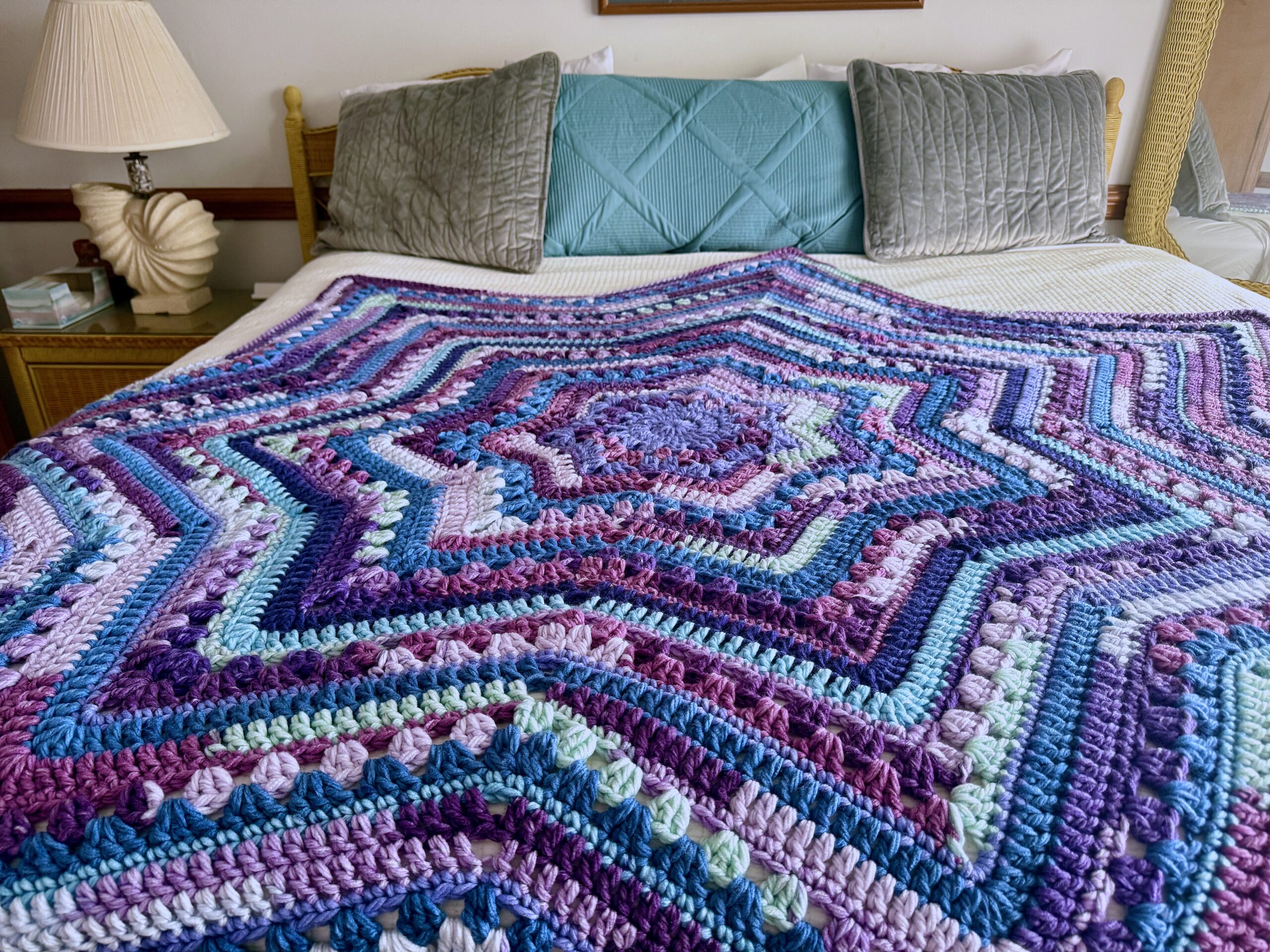
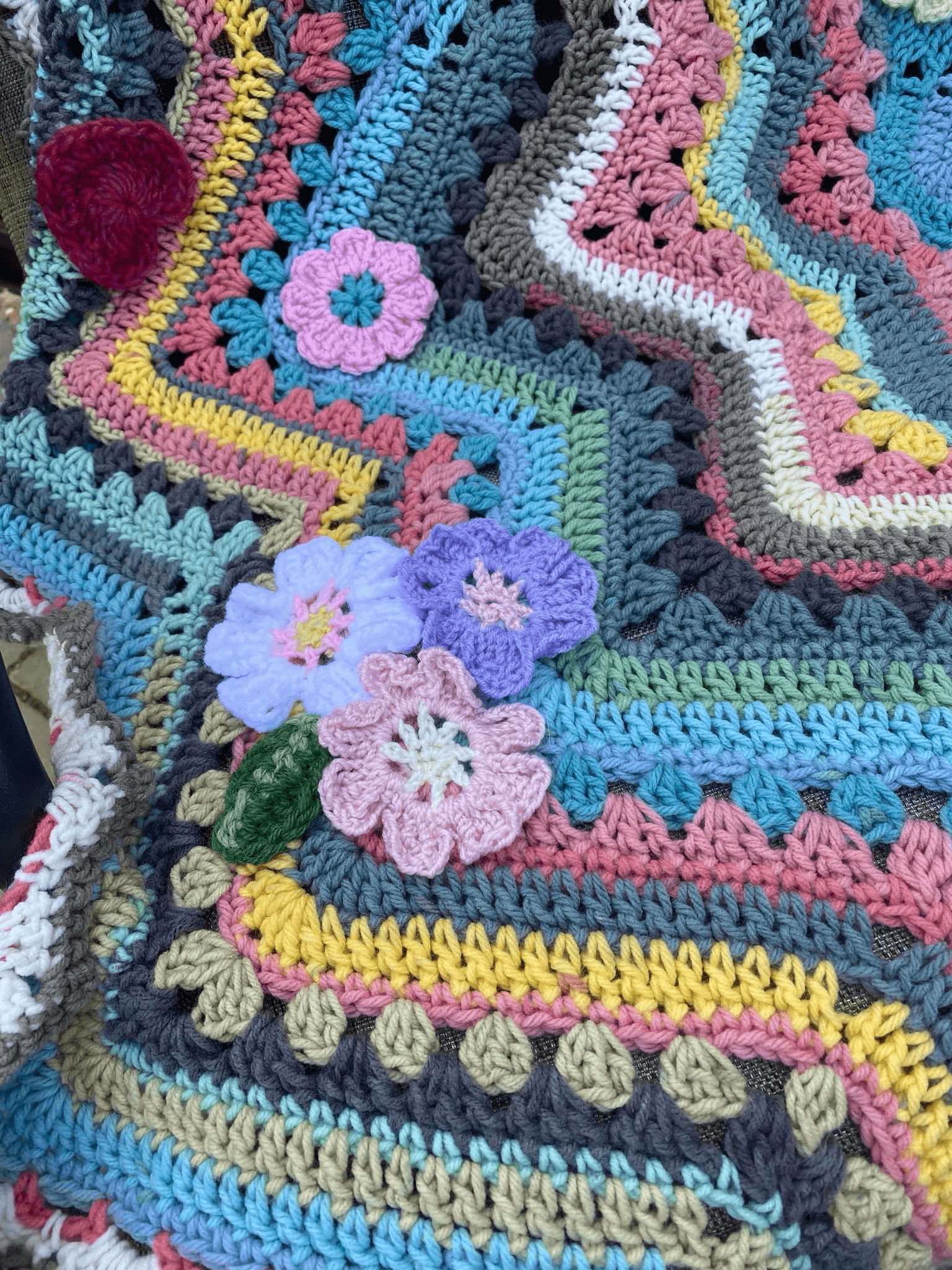
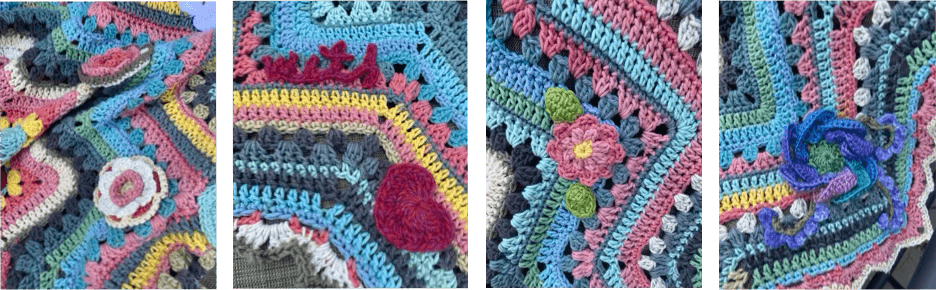
This pattern variation was created during the time of COVID-19 and is dedicated to Megan Sims. Megan was a volunteer moderator in the 6-Day Crochet Group. We remember her as someone who was always cheerful, helpful, and positive. I chose bright, mood-lifting colors for this blanket, and our crochet community covered it with crocheted hearts and flowers to comfort Megan and her family.
Crochet and color are powerful instruments of healing. I hope this pattern encourages you to let go of perfectionism, play with color, use up your stash, lighten your load, and brighten your life or someone else’s.
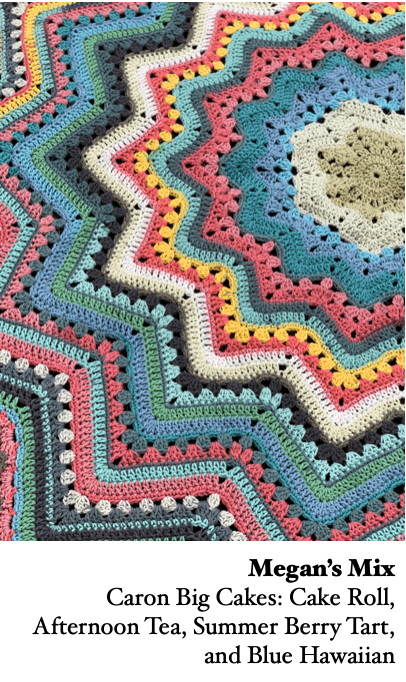
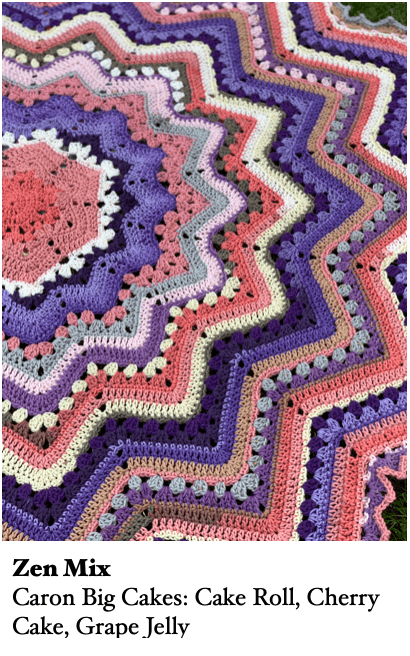
What’s the difference between this blanket and the original 6-Day Superstar Blanket?
- This pattern uses the same stitches as the original 6-Day Superstar Blanket. The original pattern is written to be adaptable to any yarn weight or blanket size. This version uses worsted weight cake yarn and makes a 60” blanket
- This version focuses on working with cake yarns and includes guidance on how to combine different self-striping yarns to create interest and meaning.
- See this article for a list of every 6-Day Star, Superstar, and Supernova pattern including holiday tree skirts, shawls, and a poncho.
Details
US Terminology with UK Conversion Chart
Finished Size:60” across
Skill Level: Easy
Gauge:13 sc – 14 rows = 4” (10 cm)
Materials
Shown in #4 Weight 100% Acrylic self-striping yarn
Caron Big Cakes in various colors.
2400 yards (4 cakes)
Specific yarns used for these blankets (some are discontinued as of 2026)
Zen Mix
- Caron Big Cakes (2400 yards total)
- Used in the following order:
- 1 Cake Roll
- 1 Grape Jelly
- 2 Cherry Cake (used for border)
Megan’s Mix
- Caron Big Cakes (2400 yards total)
- 1 each of the following (given in order)
- Afternoon Tea
- Blue Hawaiian
- Summer Berry Tart
- Cake Roll (border)
Stitch Markers
Scissors
Yarn needle for weaving in ends
To adapt this pattern to different sizes or weights, please see the 6-Day Superstar Blanket.
Hook
J (6 mm) and K (6.5 mm) hooks
Start with the smaller hook, and if the points of your star begin to curl forming a bowl in the setup rows, increase your hook by 5 mm. Lay your blanket down after each round and make sure it is laying flat.
If your work ruffles you have most likely made a mistake somewhere and added too many stitches. In my experience it is unusual to see a blanket ruffling because the hook is too big. It’s almost always because the crocheter misread the pattern and added too many stitches.
Once you’ve completed the setup rounds, there should be no need to continue to increase your hook size. If at any point you notice that the center of your blanket has a bubble, you must go back and fix it by either 1) starting over with a smaller hook in the center, or 2) increasing your hook size on the round where curling started. Unfortunately, you cannot block out a bubble once it’s formed, it must be corrected before you move on.
Abbreviations
6DKB: 6-Day Kid Blanket
6DSB: 6-Day Star Blanket
bet: between
ch: chain
dc: double crochet
dc2tog: double crochet 2 together cluster
dc3tog: double crochet 3 together cluster
picot: picot
sc: single crochet
sl st: slip stitch
sp(s): space or spaces
st(s): stitch(es)
x: times
| US terms abbreviation | UK terms abbreviation |
| single crochet sc | double crochet dc |
| half double crochet hdc | half treble crochet htr |
| double crochet dc | treble crochet tr |
Repeats
( ) Work stitches in parentheses in the same st or sp.
[ ] Repeat everything within the brackets the indicated number of times.
* Indicates beginning of repeat
** Indicates end of repeat on last repeat only.
Stitch Counts
- Stitch counts between < >
- Counts for subsequent rounds are given in parentheses like so: first repeat (second repeat, third repeat) etc.
- Unless indicated otherwise, ch 3 counts as dc.
- If your stitch counts are off, avoid the temptation to self-correct without understanding your mistake. The pattern should work out as written.
- I’ve given you stitch counts for 5 repeats. You do not have to do them all, and you can do more if you want to.
Special Stitches
dc2tog: (cluster): yo, insert hook in next st, yo, pull up a loop, yo, pull through 2 loops, yo, insert hook into same st/sp, yo, pull up a loop, yo, pull through two loops, yo and pull through 3 loops.
dc3tog: (cluster): yo, insert hook in next st, yo, pull up a loop, yo, pull through 2 loops, [yo, insert hook into same st/sp, yo, pull up a loop, yo, pull through two loops] 2 times. yo and pull through 4 loops.
picot: sc in sp or st indicated, ch 2, sc in side of sc just made.
Does it Really Take Six Days?
All of my patterns that use the same six rows alternating rows of sc, dc, and clusters, with or without chevrons, are named 6-Day Crochet. The name of this pattern comes from the original 6-Day Kid Blanket, which was toddler sized and made with chunky yarn, and took me an easy six days to make.
Tips for Completing in Six Days
To complete this project in six days, it will depend on how fast you crochet, but most crocheters will need to work 2-4 hours each day.
Day 1: Setup Rounds and the first 1/2 repeat
Day 2: Repeat 1, Repeat 2 Rounds 2-4
Day 3: Repeat 2, Rounds 5-7, Repeat 3
Day 4: Repeat 3 Rounds 5-7, Repeat 4
Day 5: Repeat 5
Day 6: Border, weave in ends.
Blankets with more than five pattern repeats will probably take longer than six days, or more than 4 hours per day to complete.
First Timers
This is an easy pattern but it is not a beginner pattern. You will need to know how to chain, single crochet, double crochet, and work in the round. This pattern doesn’t teach those skills, however, there are plenty of resources online and elsewhere to learn them. Learn those basic skills and get comfortable making a granny square. Once you’re comfortable with a granny square, you can try the 6-Day Star or Superstar.
You will also need to be brave enough to read this whole pattern and follow instructions. I have very good tutorials on YouTube that will help you, but they are only meant to help with this pattern, they are not a replacement for it. Follow the pattern along with the video, count our stitches, and if your counts are off, don’t self correct without understanding your mistake.
Finally, if this is your first or early crochet project, remember that 6-Days is the name of the stitch, not a challenge that you have to meet. It’s totally okay to take longer!
Setup Rounds/Round Numbers
There are dozens of 6-Day Crochet patterns, and in order to provide consistency across all of the 6DKB variations, I’ve numbered the rows to correspond to the original 6-Day Kid Blanket. The cluster rows are always Row or Round 2 and 3, the dc rows are always Row or Round 5 and 6, and the sc rows are always Row or Round 4 and 7. This makes it easy to adapt any pattern to the many ways there are to stripe your 6-Day Crochet projects.
You will be guided to work the rows in the proper order; don’t let the numbers throw you off or overthink a change in the sequence.
This pattern begins with eleven setup rounds which you only work once, followed by repeating rounds which are numbered 2-7. The first set of repeating rounds is a 1/2 repeat and includes only Rounds 4-7. From there you will repeat Rounds 2-7. until your blanket reaches the size you like. End on round 4. Remember that Setup Rounds are different from Rounds.
Changing Colors – All about Cake Mixing
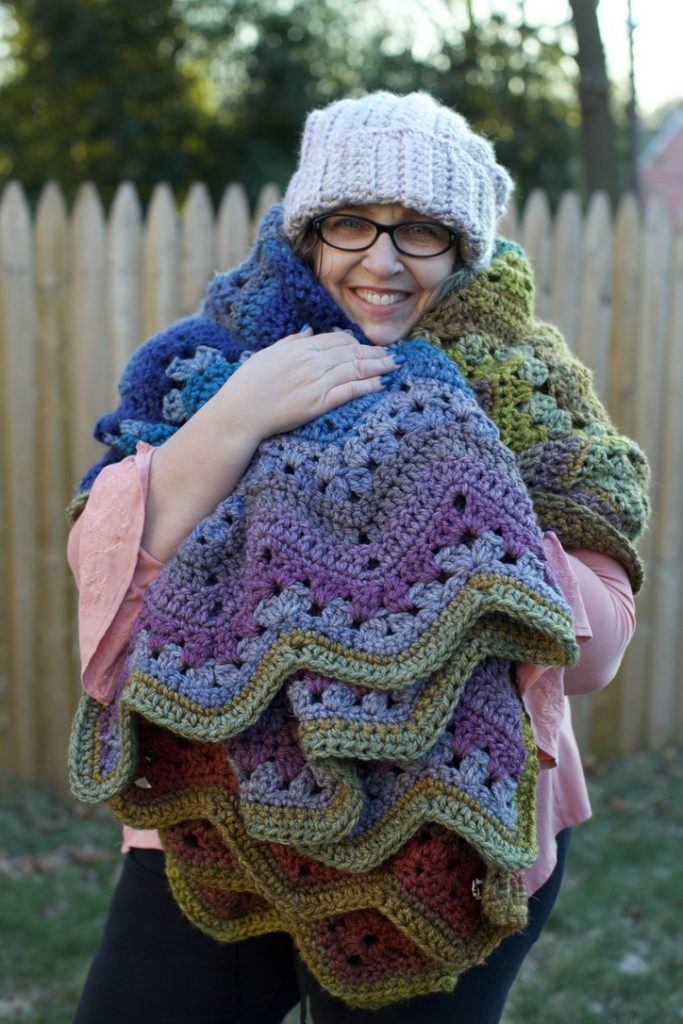
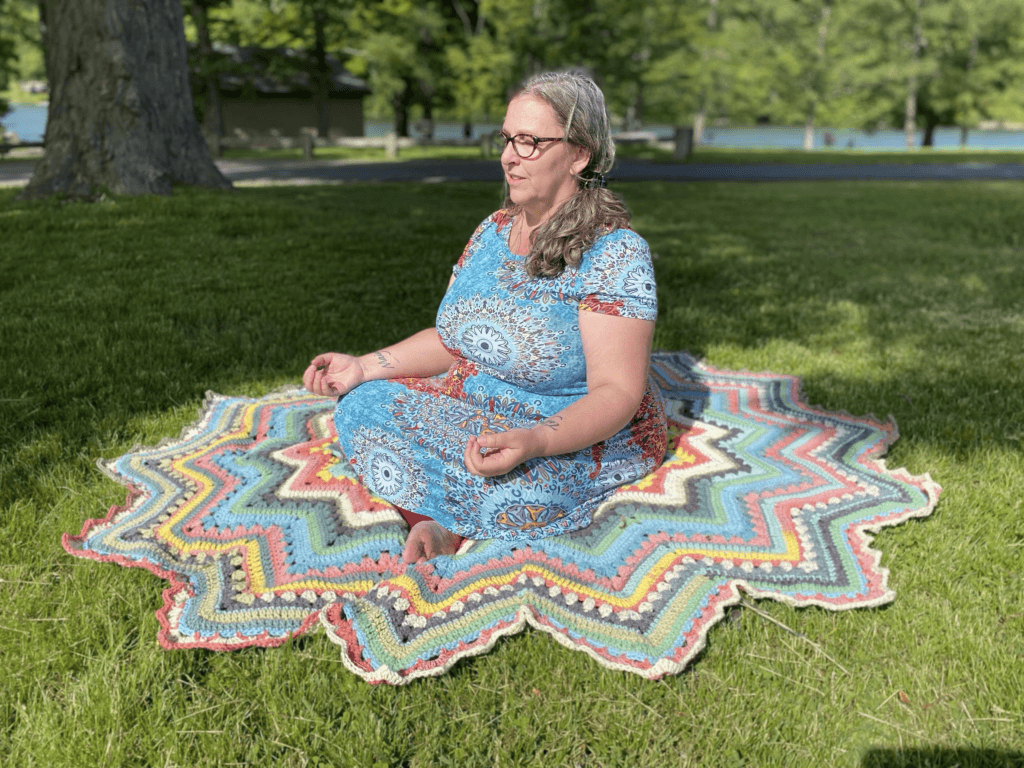
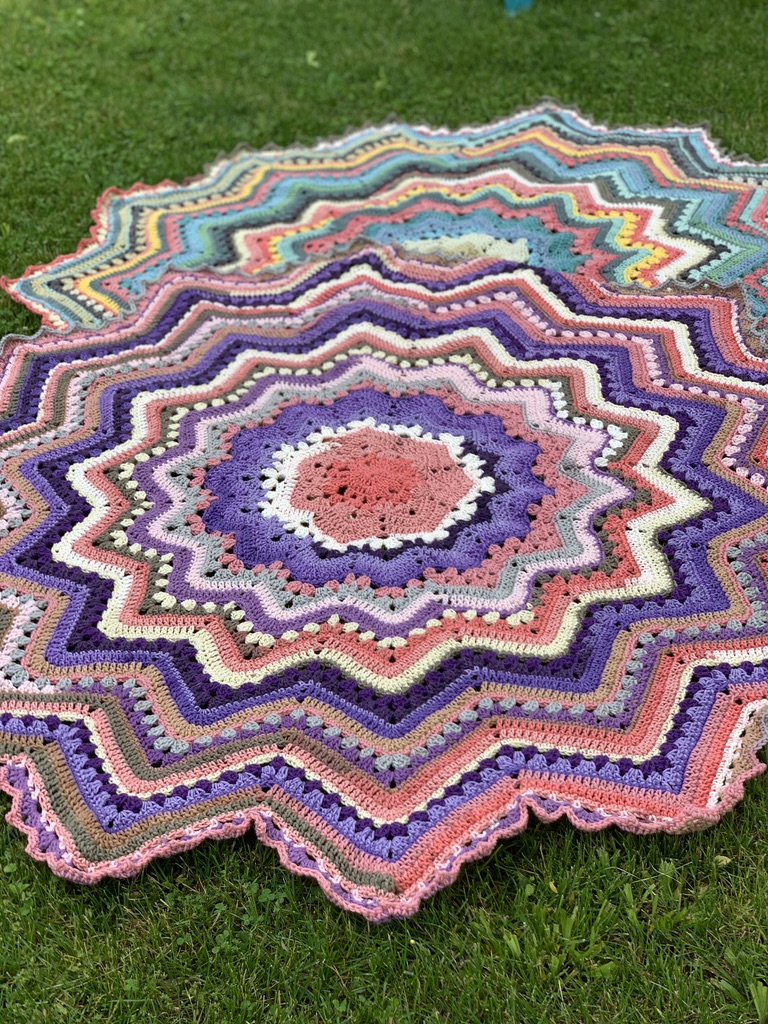
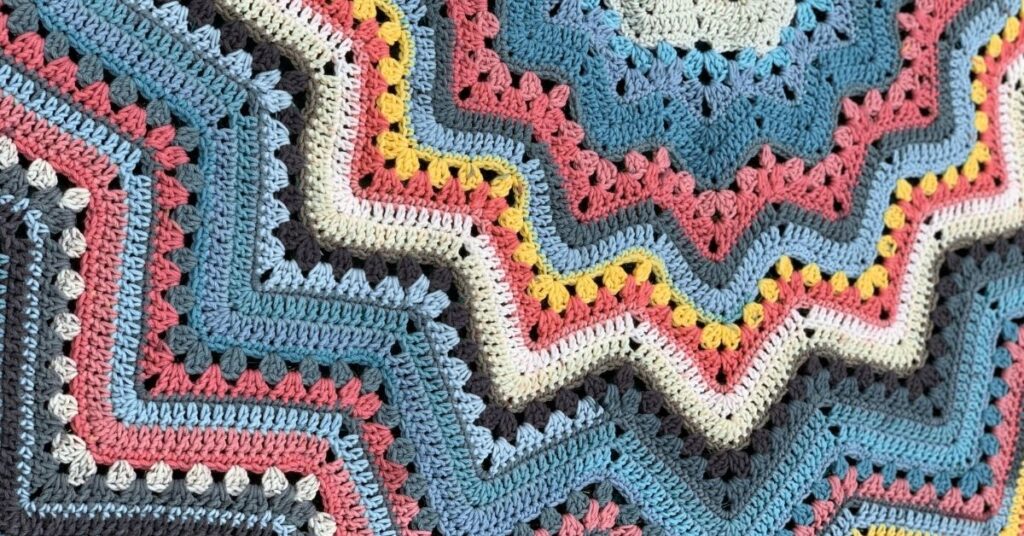
With so many cake yarns available in beautiful colors, the possibilities are endless. You can pick several skeins that share a common color story, like my Zen Mix, where I wanted mostly pink, purple, and white. Or you can go bold and mix four completely different yarns, like Megan’s Mix.
Mixing cake yarns creates even more interesting variation and happy surprises. I encourage you to be brave, experiment, and come up with your own combinations. Use up those leftover cakes you have hanging around. Challenge yourself to pick colors you would not normally choose.
When you cake-mix, let go of the need to know exactly how it will turn out. There is an element of chance and trust involved. Even if you use the exact same yarns and colors I did, your blanket will look different from mine. You cannot control exactly where the stripes and colors will fall, and that is part of the beauty.
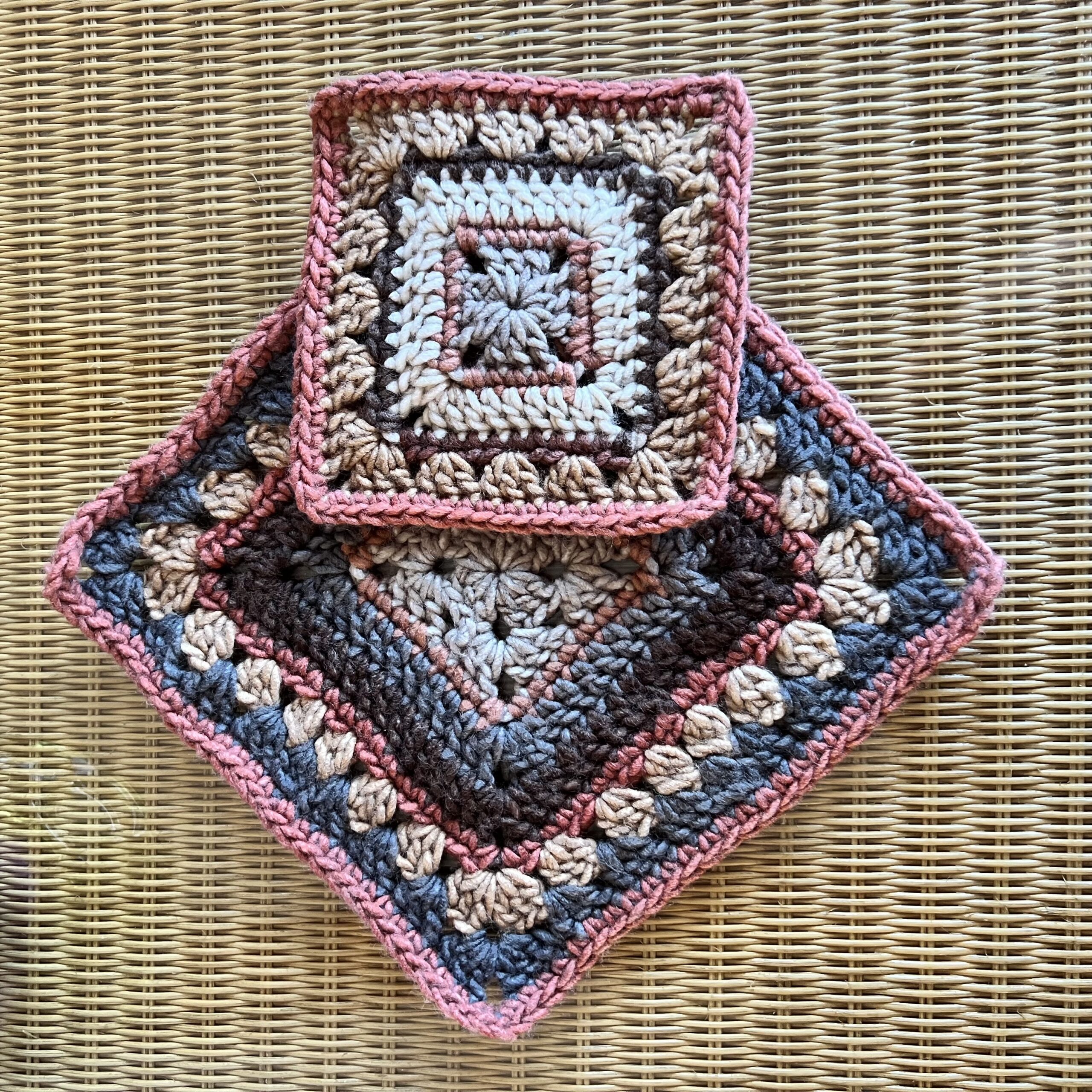
You can even get creative and combine yarns that seem like they have no business being together. Choose cakes because of their names, or because each one reminds you of something that makes you feel good. I once made a cake-mix blanket in warm neutrals I knew the recipient would love. I added splashes of blue to represent the community we both belonged to. The blue became a reminder that we would always be part of her, even after she moved away. (Shown in photo: Rupi’s Mix)
How can you use color to bring meaning to your project?
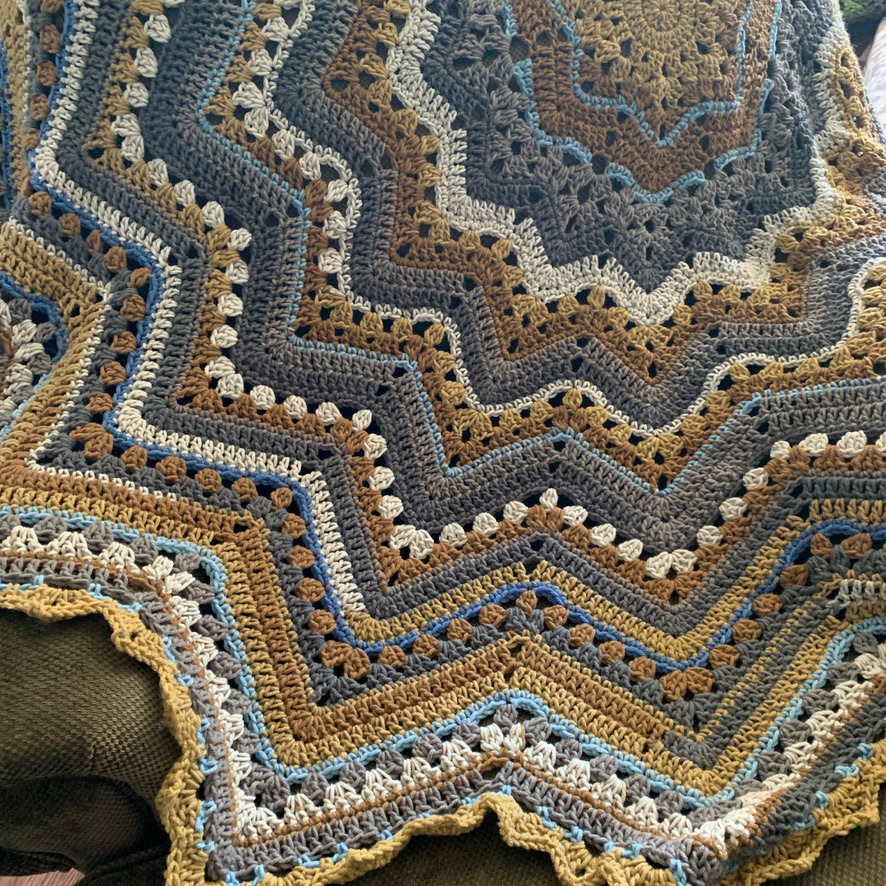
When you mix cakes and new colors, give them a chance to develop before deciding whether you like them. I have often disliked the first few rows of a project, only to fall in love with it a few rounds later. If you are unsure, set it aside for a few days and look at it again with fresh eyes. Take some chances. You may surprise yourself.
The first 6 to 9 rows of this version look best when the yarn does not change color in the middle of a round. If you are using cake yarn, you may want to buy an extra cake so you can cut and control the color for those beginning rounds. After the center is established, mid-round color changes become much less noticeable.
This pattern will not tell you when to change colors; you are encouraged to play. With each of these blankets, I controlled the first eight rounds to avoid mid-row color changes. After that, I let the colors flow freely. I worked through the cakes for about one repeat of the pattern, or less if I got bored or if too many similar colors were lining up. I kept the order of the cakes unless I felt like skipping to a different one. Each cake was used twice in the blanket.
When changing colors, fasten off the old color. Rotate the work and begin the next color with a standing stitch in a different valley.
Joining the Rounds
This pattern is worked in the round without turning. Take care that you do not create extra stitches when you join your rounds, especially the sc rounds. See my YouTube Channel for a tutorial video guiding you to use stitch markers at the start of the sc rounds.
Photo and Video Tutorials
This pattern includes a photo tutorial of the Setup Rounds and one repeat from the 6-Day Superstar Blanket.
The 6-Day Superstar Blanket has video tutorials on YouTube. The tutorials are meant to help you understand this pattern, but they are not intended to replace this pattern or be used without it. Be sure to follow community guidelines when commenting on the videos.
Community Support
I am available on multiple social media platforms. The best way to get support is through my Facebook community dedicated to helping crocheters with the 6-Day Crochet Projects, loaded with free resources and people to answer your questions.
Join my membership community The Betty McKnitiverse for bonus content, exclusive 6-Day Star Blanket variations not published elsewhere (including a 16-point 6-Day Superstar), and ask your questions directly during one of my many community zoom calls.
An international community of yarnful makers and friends.
- Supportive community dedicated to the Power of Positive Crochet
- New pattern pre-releases
- Exclusive patterns never released to the public
- 3-5 patterns each month from Betty’s library (dripped out on pre-determined schedule)
- Somatic Crochet support and education
- Crochet alongs, knit alongs, and classes
- Weekly social and educational events and Zoom Hangout
- Bonus content every month
Begin Pattern
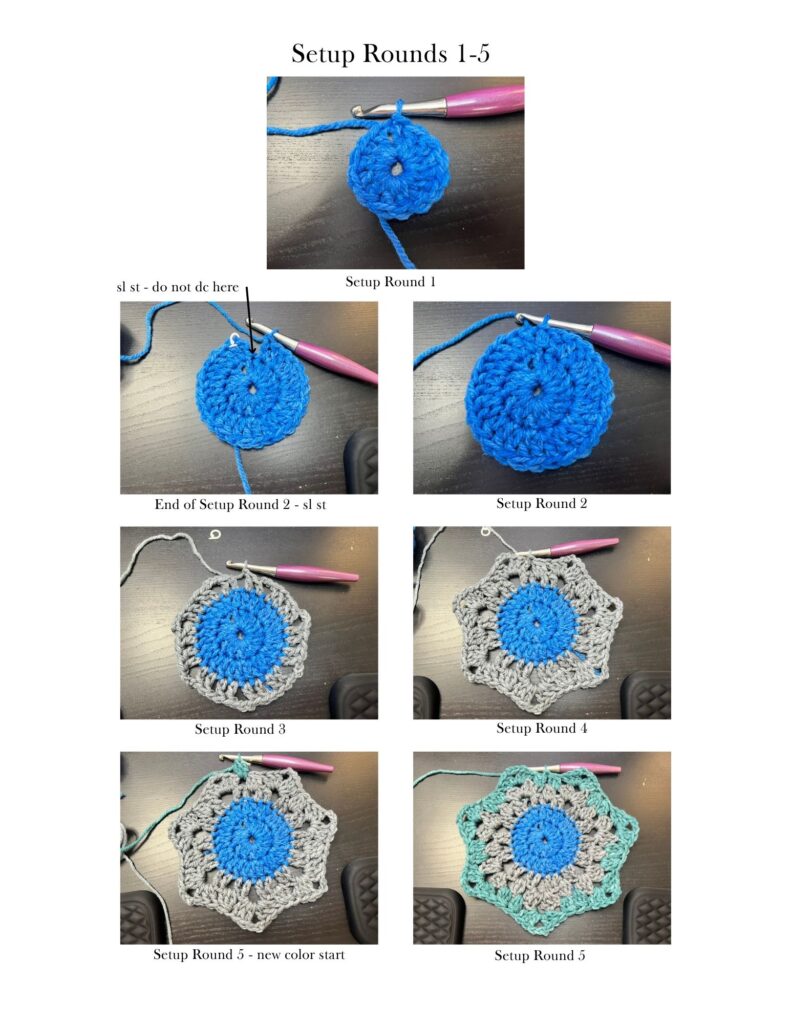
With any color and smaller hook, ch 4, join with sl st to form a ring (magic ring not recommended).
Setup Round 1: ch 3 (counts as dc, here and throughout), 13 dc into ring, join with sl st to top of ch 3.
<14 dc>
Setup Round 2: ch 3, dc in same st. 2 dc in each st around. Join with sl st to top of ch 3.
<28 dc>
Setup Round 3: ch 3, dc in next st, *ch 3, dc in next 2 sts, ch 1 **, dc in next 2 sts, repeat from * ending last repeat at **, join with sl st to top of ch 3.
<28 dc, 7 ch-3 sps, 7 ch-1 sps>
Setup Round 4: sl st in next dc and ch-3 sp, (ch 3, 2 dc, ch 3, 3 dc) in same sp, *dc3tog in ch 1 sp, (3 dc, ch 3, 3 dc) in ch-3 sp, repeat from * around, dc3tog in last ch-1 sp, join with sl st to top of ch 3.
<14 3-dc clusters, 7 ch-3 sps, 7 dc3tog>
Remember to lay your work down after every round and check your tension. If you experience significant curling — you attempt to press your work flat, if there are parts that pop up or pucker, or your work is forming the shape of a bowl, change to a .5 – 1 mm larger hook. If your work does not cup or significantly curl, you do not need to change hooks.
Once you complete the Setup Rounds, you should not need to change your hook again.
Setup Round 5: sl st into the gap just below your hook, between the dc3tog and the 3 dc, (ch 2, dc2tog) in same sp, *(3 dc, ch 3, 3 dc) in ch-3 sp, **dc3tog in next 2 sps, repeat from * ending last repeat at **, dc3tog in last sp, join with sl st to top of dc2tog cluster (be sure to join in the top of the cluster and not to the ch 2).
<14 3-dc clusters, 7 ch-3 sps, 14 dc3tog>
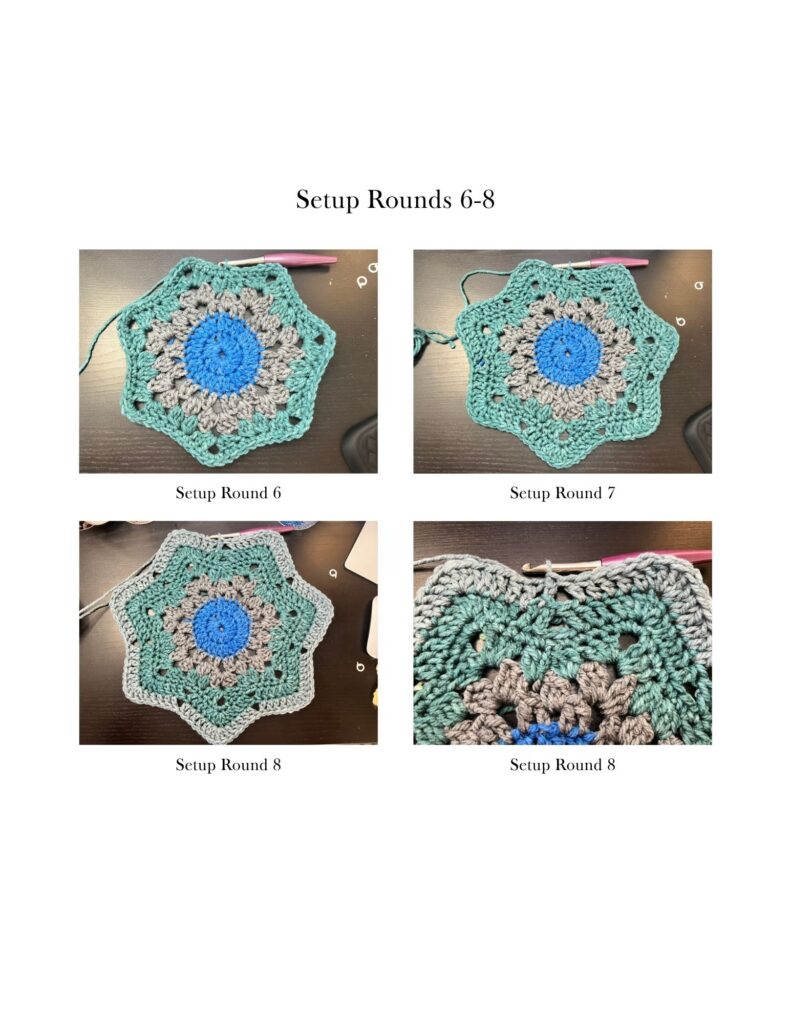
Setup Round 6: ch 1, sc in same st, sc in each st around, working 3 sc in ch-3 sps. Join with sl st to first sc (be sure to join to the top of the sc and not the sl st, here and throughout).
<77 sc>
Setup Round 7: sl st in next st, ch 3, dc in next 3 sts, *(5 dc in center sc from row below), dc in next 4 sts,** sk 2, dc in next 4 sts, repeat from * ending last repeat at ** sk 2, join with sl st to top of ch 3.
<91 dc>
Since we are always working from the right side, the top of the center st in the peaks lies not directly above, but slightly to the right of the center stitch.
Setup Round 8: sl st in next st, ch 3, dc in next 4 sts, *(5 dc in center sc from round below), dc in next 5 sts, sk 2, ** dc in next 5 sts, repeat from * ending last repeat at ** , join with sl st to top of ch 3.
<105 dc>
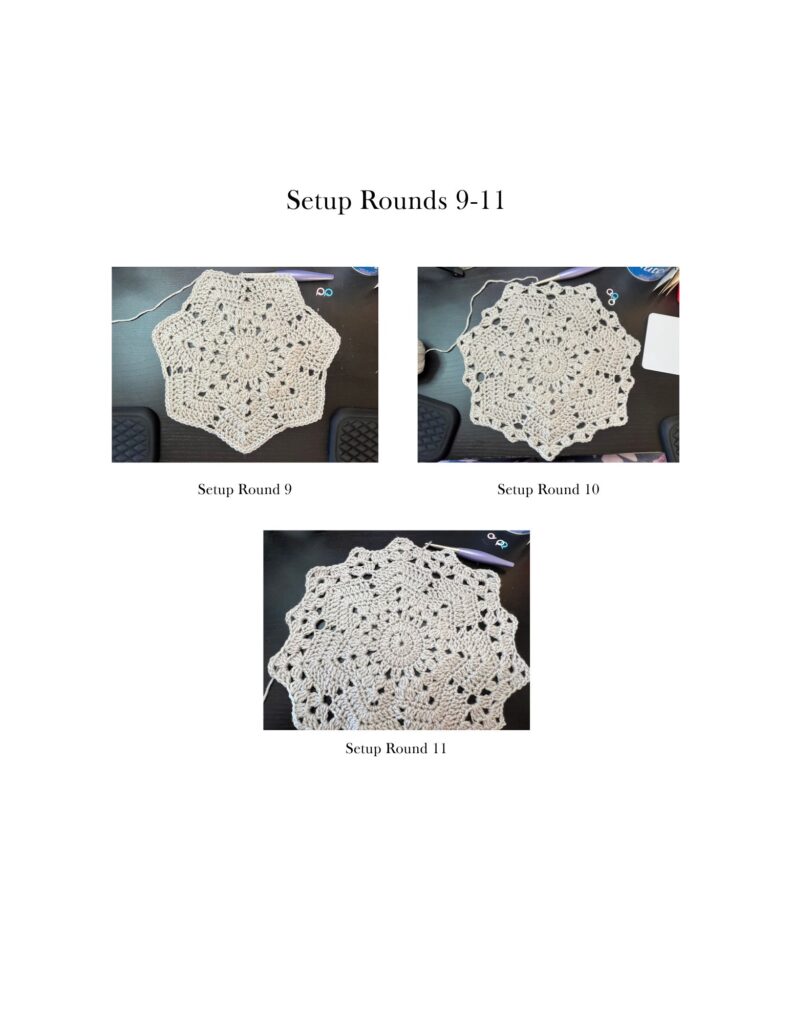
Set-up Round 9: sl st, ch 1, sc in same st, sc in next 5 sts, *3 sc in center dc from the round below, sc in next 6 sts, ch 3, sk 2,** sc in next 6 sts, repeat from *around, ending with **. Join with sl st to first sc.
<105 sc, 7 ch-3 sps>
Setup Round 10: sl st in the next 3 sts, ch 2, dc2tog cluster in same st, *ch 1, sk 3, (3 dc, ch 3, 3 dc) in center sc from row below, ch 1, sk 3, dc3tog, ch 1, sk 3, (3 dc, ch 3, 3 dc) in ch-3 sp, ch 1, sk 3,** dc3tog in next st, repeat from * around, ending with **, join with sl st to top of starting dc2tog.
<28 3-dc clusters, 14 dc3tog>
Setup Round 11: sl st into next ch-1 sp, ch 2, dc2tog in same sp, *(3 dc, ch 3, 3 dc) in ch-3 sp, ** dc3tog in next 2 sps (one before and one after the dc3tog in the row below), repeat from * around ending with ** dc3tog in the last sp, join with sl st to first dc2tog. <28 3-dc clusters, 28 dc3tog>
Setup Rounds Complete. Proceed to Half Repeat starting with Round 4. Do not repeat the Setup Rounds.
Half Repeat
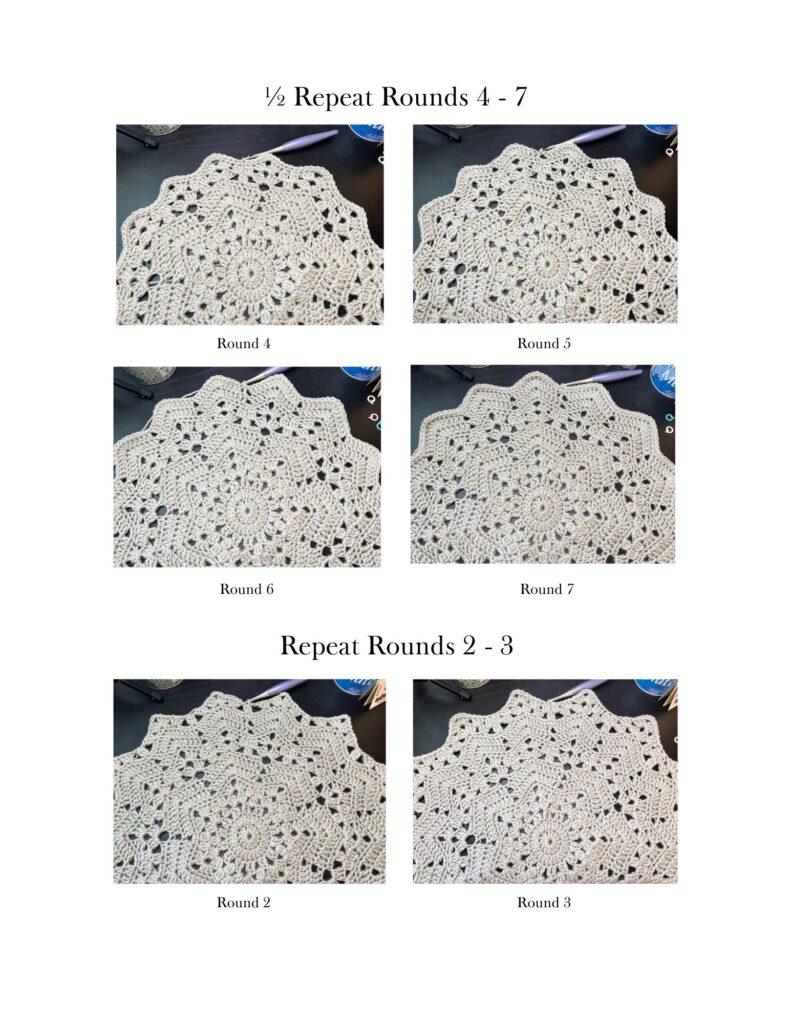
Round 4: ch 1, sc in same st, sc in each st around, working 3 sc in ch-3 sps. Join with sl st to first sc.
<8 sc between each peak, 3 sc in each ch-3 sp>
Round 5: sl st in next st, ch 3, dc in next 3 sts, *(5 dc in center sc in peak), dc in next 4 sts, sk 2, ** dc in next 4 sts, repeat from *, ending last repeat at **, join with sl st to top of ch 3.
<8 dc between each peak, 5 dc in each peak st>
Round 6: sl st in next st, ch 3, dc in next 4 sts, *(5 dc in center dc in peak), dc in next 5 sts, sk 2, ** dc in next 5 sts, repeat from *, ending at **, join with sl st to top of ch 3.
<10 dc between each peak, 5 dc in each peak st>
Round 7: ch 1, sc in same st and each st around, making 2 sc in each center of 5 dc in the peak. Join with sl st to first sc.
<14 between each peak and 2 sc in each peak st>
Half Repeat Complete. Proceed to full repeats of Rounds 2-7.
Full Repeats
Round 2: ch 2, dc2tog cluster in same st (mark this st), *ch 1, sk 4, [3 dc in next st, sk 2] 1 (2, 3, 4, 5) x, (3 dc, ch 3, 3 dc) in second of 2 sc in peak, [sk 2, 3 dc in next st] 1 (2, 3, 4, 5) x, ch 1, sk 4, ** dc3tog in next st, repeat from * , ending last repeat at **, join with sl st to top of starting dc2tog.
<56 (84, 112, 140, 168) 3 dc clusters, 14 ch-3 sps, 14 dc3tog>
Round 3: sl st in next sp, ch 2, dc2tog in same sp (mark this st), *3 dc in each of next 1 (2, 3, 4, 5) sps, (3 dc, ch 3, 3 dc) in ch-3 sp, 3 dc in each of next 1 (2, 3, 4, 5) sps, ** dc3tog in next 2 ch-1 sps (one before and one after the dc3tog in the round below), repeat from * ending last repeat at **, dc3tog in last sp. Join with sl st to marked dc2tog.
<56 (84, 112, 140, 168) 3 dc clusters, 14 ch-3 sps, 28 dc3tog>
Round 4: ch 1, sc in same st, sc in each st around, working 3 sc in ch-3 sps. Join with sl st to first sc.
<14 (20, 26, 32, 38) sc between each peak, 3 sc in each ch-3 sp>
On subsequent sc rounds, the number of scs between the peaks will increase by 6. The numbers in parentheses show the number of scs on each subsequent repeat of the pattern.
Round 5: sl st in next st, ch 3, dc in next 6 (9, 12, 15, 18) sts, *(5 dc in center sc in peak), dc in next 7 (10, 13, 16, 19) sts, sk 2, ** dc in next 7 (10, 13, 16, 19) sts, repeat from *, ending last repeat at **, join with sl st to top of ch 3.
<14 (20, 26, 32, 38) dc between each peak, 5 dc in each peak st>
Round 6: sl st in next st, ch 3, dc in next 7 (10, 13, 16, 19) sts, *(5 dc in center dc in peak), dc in next 8 (11, 14, 17, 20) sts, sk 2, ** dc in next 8 (11, 14, 17, 20) sts, repeat from *, ending at **, join with sl st to top of ch 3.
<16 (22, 28, 34, 40) dc between each peak, 5 dc in each peak st>
On subsequent rounds 5 and 6, the number of dcs on either side of the peak will increase by 3. The numbers in parentheses show the number of dcs on each subsequent repeat of the pattern.
Round 7: ch 1, sc in same st and each st around, making 2 sc in each center of 5 dc in the peak. (Since we are working on all right sides and not turning, the top of the center dc is above and slightly to the right of the center stitch). Join with sl st to first sc.
<20 (26, 32, 38, 44) between each peak and 2 sc in each peak st>
Repeat Rounds 2-7 in that order approximately 4 times more for a total of 5 full repeats. Do not repeat the Setup Rounds or the 1/2 repeat. Follow the stitch counts given in the parentheses for each round as you progress. I’ve given you stitch counts for 5 repeats. You do not have to do them all, and you can do more if you have more yarn. You can finish on Round 4 or 7 before moving on to your edge.
Fasten off. Continue to Finishing.
Finishing
This edge is an adaptation of Pattern #101 from Around the Corner Crochet Borders by Edie Eckman.
I have many other edges on my other 6-Day Crochet patterns, and many of them are interchangeable. Visit my website, bettymcknit.com to explore pattern edges, or join the Betty McKnitiverse for my library of original crochet border edges.
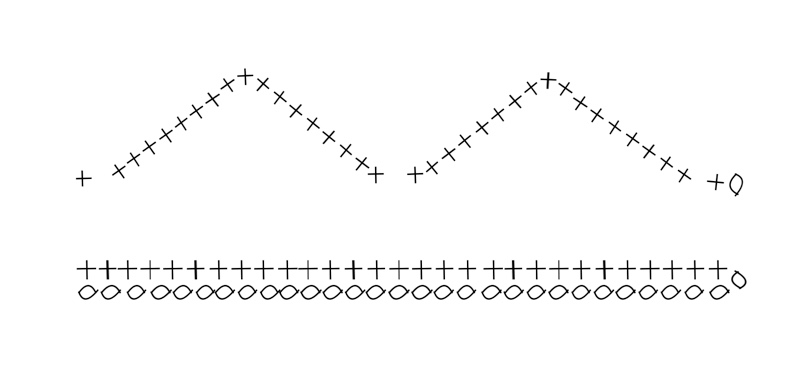
Edge Round 1: Join with sc in any peak in the st before the 2 sc in the peak st. *ch 3, sk 2, sc in next st, repeat from * around, adjusting the number ch-sps and skips in order to have a ch-sp centered over each valley, an even number of ch-sps between the peaks and valleys, and a ch-sp over each peak. Your numbers may work out differently than mine, and precision isn’t necessary. Join with sl st into first sc.
Edge Round 2: sl st into next ch-3 sp, ch 3 (counts as first dc), (3 dc, ch 2, 4 dc) in ch-3 sp, sc in next sp, *(3 dc, ch 2, 3 dc) in next ch sp, sc in next sp, repeat from * around, working (4 dc, ch 2, 4 dc) in peaks and (3 dc, ch 2, 3 dc) elsewhere. You should always land in the valley with an sc. Join with sl st to first st.
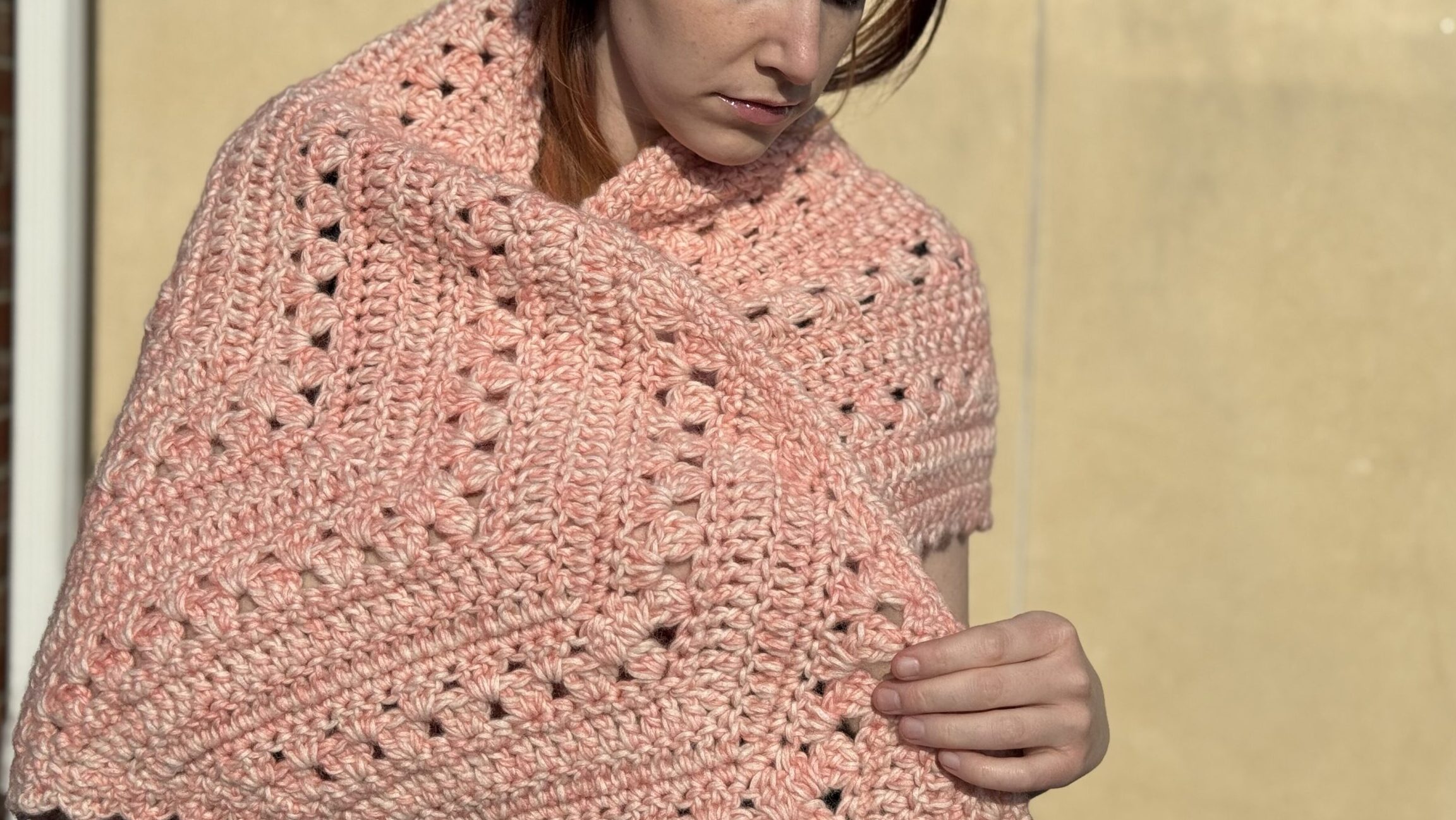
Edge Round 3: ch 1, sc in same st, sc in each stitch around, work sc, picot, sc in each ch sp on the points. Join with sl st to first sc.
Fasten off. Weave in all ends.
This pattern is the intellectual property of Beth McKee Elliott aka Betty McKnit®. This pattern, The 6-Day Kid Blanket, 6-Day Crochet™, 6-Day Star Blanket™, and all derivative works are protected by copyright. Publishing translations, corrections, variations, or tutorials of this pattern, online or elsewhere without written permission from the owner is a violation of copyright.
Items created with this pattern may be used for commercial sale with credit to Betty McKnit in your listing. Mass production is not permitted.
The 6-Day Crochet stitch pattern was inspired by “Vivid Chevrons” #110 from 200 Ripple Stitch Patterns by Jan Eaton.
©Beth McKee Elliott/Betty McKnit®
www.bettymcknit.com
#colorformood #somaticcrochet #superstarblanket #6daystarblanket
Beth McKee Elliott
aka Betty McKnit
Beth McKee Elliott, also known as Betty McKnit, is a crochet and knitting designer, instructor, community leader, and Master Somatic Movement Therapist and Educator. Her signature style, 6-Day Crochet, is showcased in the viral crochet patterns the 6-Day Kid Blanket and 6-Day Star Blanket.
She specializes in Somatic Crochet and Knitting, a mindfulness practice that combines crochet/knitting with body awareness techniques to prevent injury and promote well-being and creativity in crafting.
In addition to being a crochet designer, Beth is a choreographer. She is the creator and director of Small Plates Choreography Festival, Haven Movement Company, and the Dance Maker Podcast.