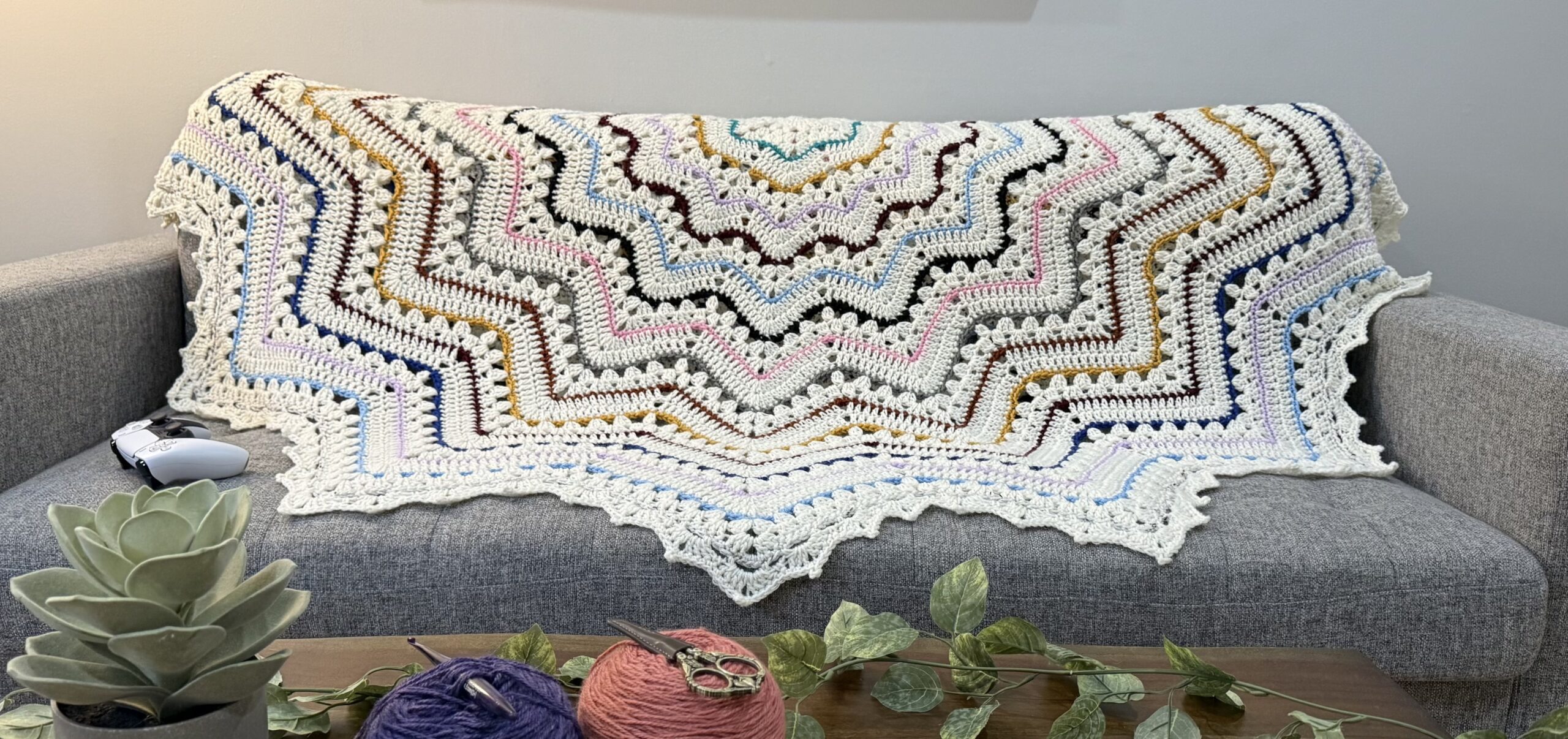
Halfway Home on Tranquil Trails
Halfway Home on Tranquil Trails
A 6-Day Crochet Pattern by Betty McKnit
This page contains affiliate links. If you click these links and buy something on the page they take you to, I may, at no additional cost to you, earn a commission. I only affiliate with products and companies I feel good about. Thank you for your support!
Introduction
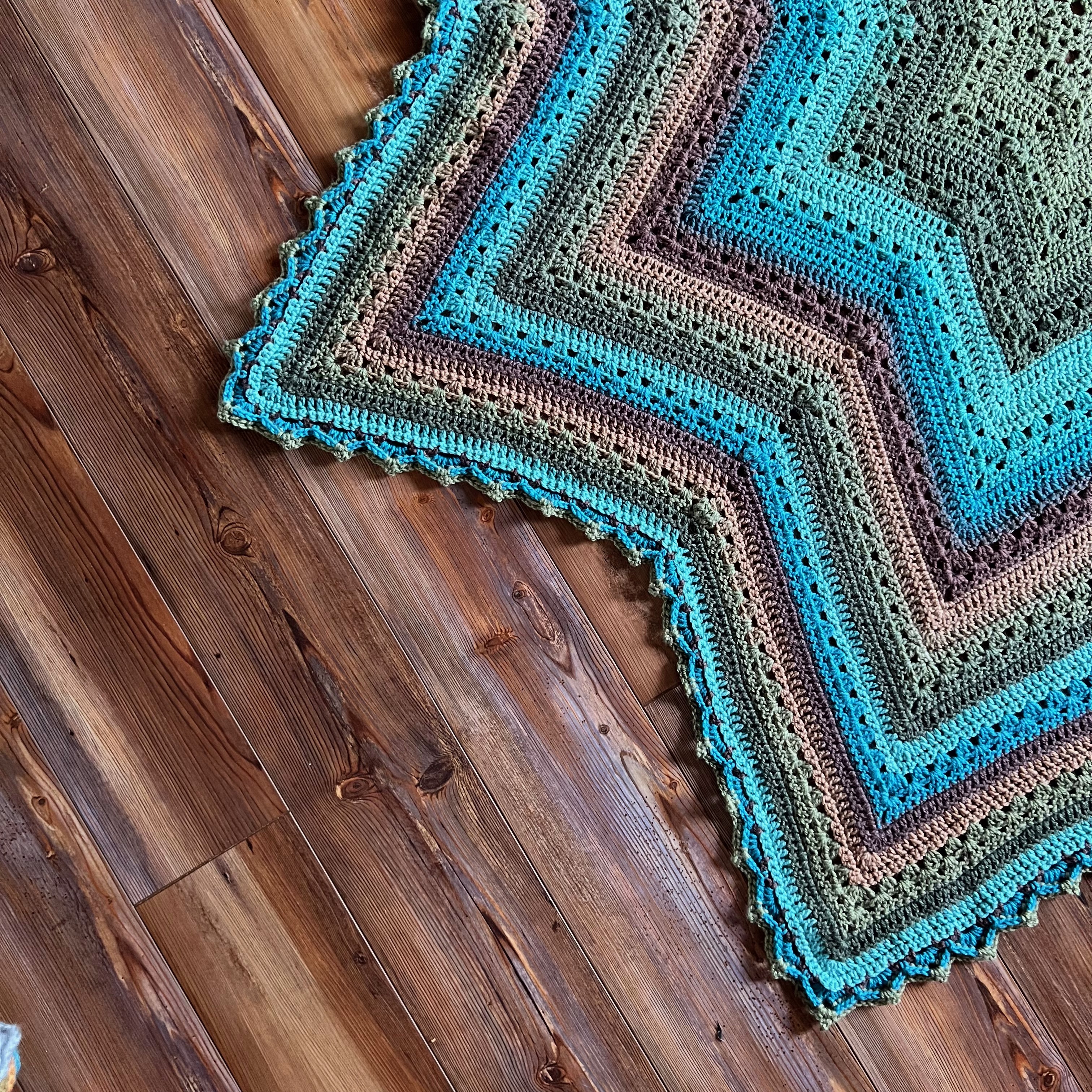
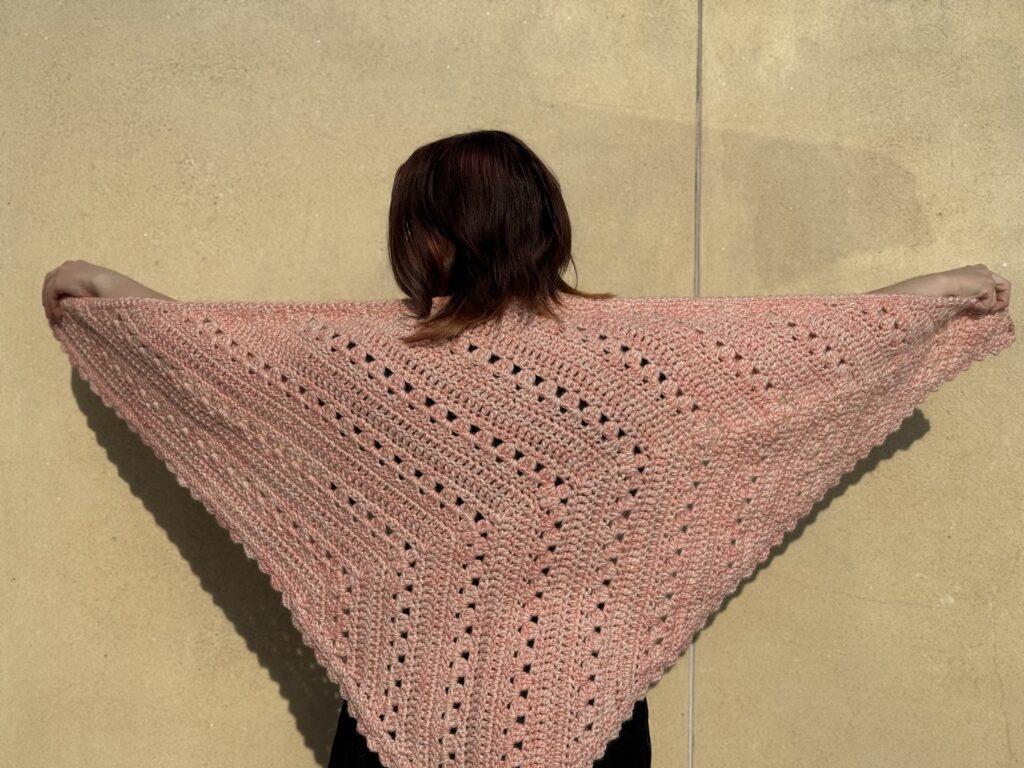
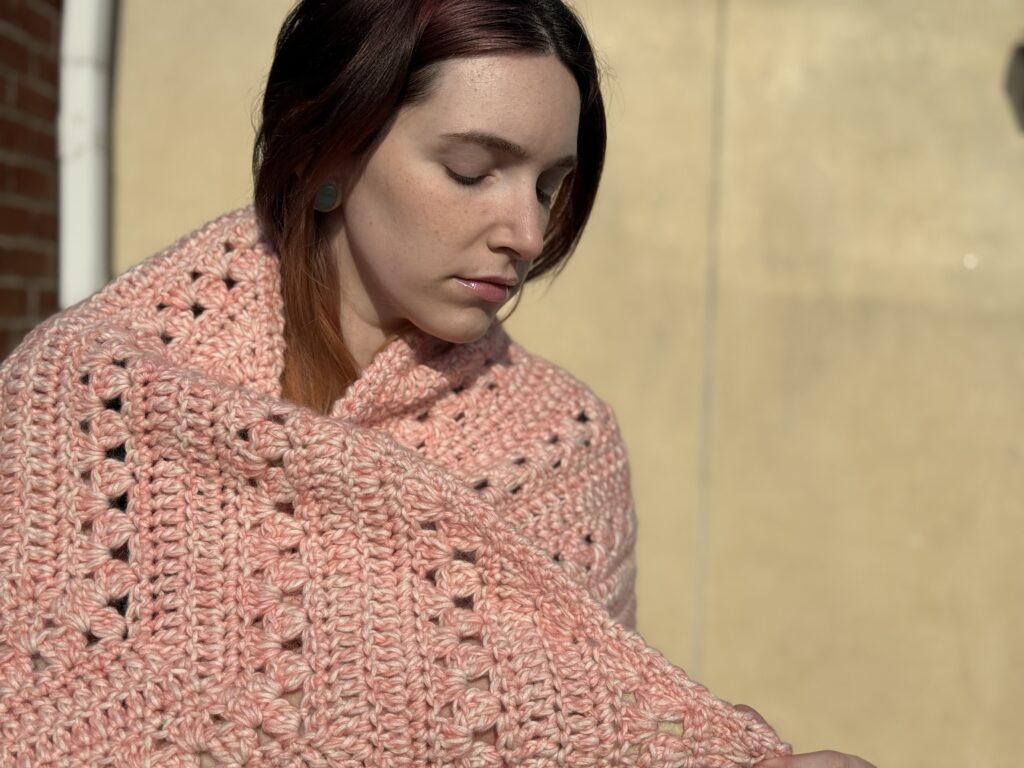
Halfway Home on Tranquil Trails is a triangular crochet scarf in the style of 6-Day Crochet™. It has a fun and unusual construction and makes a very easy-to-wear bandana, scarf, wrap, or shawl. Infinitely adaptable, use your favorite hand-dyed skeins, color changing yarns, solid colored luxury fibers, or hold yarns together for stunning wearable works of art.
This design is meant to efficiently use up any amount of yarn that you have. The Halfway Home approach means you may not know exactly what size your finished scarf will be. All you need is 230 yards of DK weight yarn to make a bandana scarf, or break out the stash for a statement blanket scarf, and everything in between. This is the perfect pattern to show off those stash yarns you bought without a project in mind.
This pattern is exactly the same stitches as the 6-Day Tranquil Trails Scarf, but it is written to be completely adaptable to different weights and amounts of yarn. Before starting, divide your yarn in half (my Halfway Home patterns are why I always buy two of everything – it’s already divided in half that way!) You can also divide your yarn by weight. Work the Setup Rows and increase section, continuing until you’ve used half of your yarn by weight or yardage. Then begin the decrease section, and finally, complete the edge and border.
This pattern is provided free with advertisements on this page. If you would like an ad-free .pdf, you can purchase one at the bottom of the page. The .pdf is the same as this pattern, with the exception of the ads.
Similar Patterns:
Details
US Terminology with UK Conversions
Skill Level: Intermediate
This project contains simple stitches, but the shaping concepts may be confusing for beginners. The adaptability may also be overwhelming for new crocheter. Less experienced crocheters can start with the Tranquil Tides Scarf which gives specific counts, yardage, and measurements.
Finished Size: Variable
Size shown: 60” w x 24” l
Gauge: (it is not important to match gauge)
| US terms abbreviation | UK terms abbreviation |
| single crochet sc | double crochet dc |
| half double crochet hdc | half treble crochet htr |
| double crochet dc | treble crochet tr |
Materials
This pattern was designed to be adaptable to any weight and amount of yarn.
Shown in Camellia Fiber Company, Som DK
50% Pima Cotton, 42% Baby Alpaca, 8% Merino.
1312 Yards total
4 skeins each of Carnation and Pink Lemonade
Scarf was made holding one strand of each color together throughout.
Yardage estimates for #3 DK Weight yarn (held single) – adapted from Halfway Home on Metro North.
Bandana Size 34” w x 14” l: 230 yards
Scarf 54” w x 23.5” l: 590 yards
Shawl 60” w x 26” l: 1000 yards
Blarf (Blanket Scarf) 68” w x 38” l: 1200 yards
Abbreviations
bet: between
ch: chain
dc: double crochet
dec dc2tog: decrease double crochet two together
dc2tog over 2: decrease double crochet two together over two stitches
dc2tog over 3: decrease double crochet two together over three stitches
dc3tog: double crochet three together cluster
edc: extended double crochet
rep: repeat
sc: single crochet
sl st: slip stitch
sk: skip
sp(s): space(s)
st(s): stitch or stitches
st3sc: stacked single crochet x 3
st3sc: 3 stacked single crochet
sc2tog: decrease single crochet two together
sc2tog over 3: decrease single crochet two together over three stitches
x: times
sp(s): space(es)
yo: yarn over
| US terms abbreviation | UK terms abbreviation |
| single crochet sc | double crochet dc |
| half double crochet hdc | half treble crochet htr |
| double crochet dc | treble crochet tr |
Special Stitches
dec dc2tog: [yo, pull up a loop in the next st/sp, yo, pull through two loops] twice. yo and pull through all loops on the hook.
dc2tog over 2: yo, pull up a loop in the next stitch, yo and pull through two loops leaving the rest of the stitch unworked, yo, pull up a loop in the next stitch, yo and pull through two loops, yo and pull through all remaining loops.
dc2tog over 3: yo, pull up a loop in the next stitch, yo and pull through two loops leaving the rest of the stitch unworked, sk the next st, yo, pull up a loop in the next stitch, yo and pull through two loops, yo and pull through all remaining loops.
dc3tog: (cluster): yo, insert hook in next st/sp, yo, pull up a loop, yo, pull through 2 loops, [yo, insert hook into same st/sp, yo, pull up a loop, yo, pull through two loops] 2 times. yo and pull through 4 loops.
edc: yo, pull up a loop in the next st, yo and pull through one loop on the hook, [yarn over and pull through two loops on the hook] twice.
sc2tog: pull up a loop in each of the next 2 sts, yo and pull through both loops on the hook.
sc2tog over 3: pull up a loop in next sts, sk next st, pull up a loop in the next st, yo and pull through both loops on the hook.
st3sc: stacked single crochet x 3 (counts as 1 st): work sc into stitch or space indicated, work sc into left side loop of sc just made. Work a third sc into side of second sc for 3 stsc.

Construction
Worked back and forth (turn after each row) starting from one corner and increasing on both sides.
Work the Setup Rows one time and proceed to Increase Rows. Do not repeat Setup Rows.
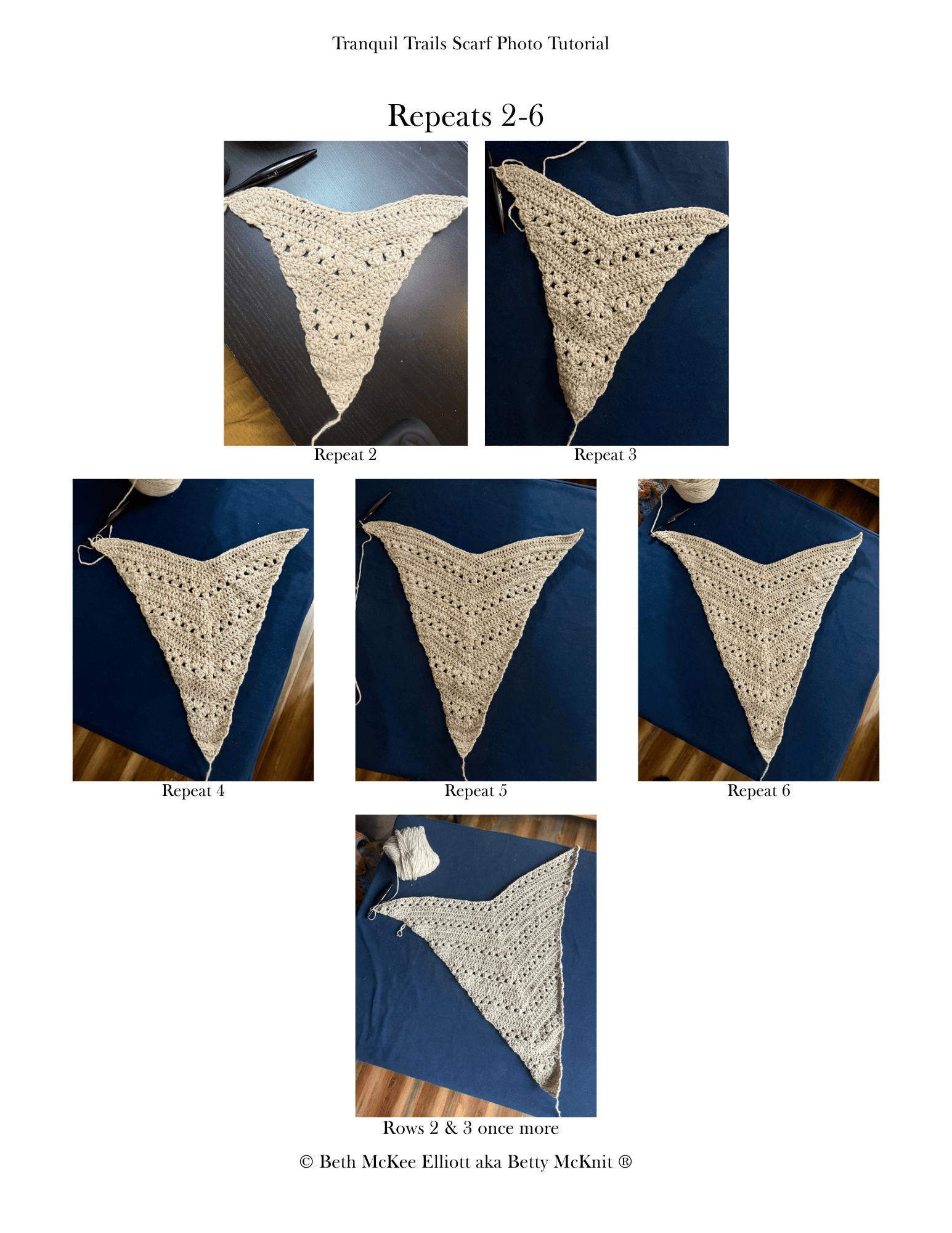
Repeat Increase Rows 2-7 until you have used ½ of your yarn. Proceed to Decrease Rows.
The work will now decrease on one side, and continue to increase along the other until the decreases meet the chevron point in the center of the scarf.
Work a round of single crochet around the entire scarf and a border along two or three sides as desired.
Repeats
( ) Work in the same st or sp.
[ ] Repeat everything within the brackets the indicated number of times.
Stitch Counts
- Row stitch counts between < >
- Stitch counts in decrease section given as +/- number of stitches from previous row
- Counts for subsequent rounds are given in parentheses like so: first repeat (second repeat, third repeat) etc.
- I’ve provided stitch counts for eleven repeats of the increase rows. You can do more or less as desired.
- st3sc/stdc counts as dc
- First stitch of the row, stitch below the chain, counts as first stitch unless otherwise indicated
Notes
- Unless otherwise indicated, do not ch 1 before st3sc
- st3sc counts as 1 st
- st3sc can be replaced with ch 3, or stsc
Does it Really Take 6 Days?
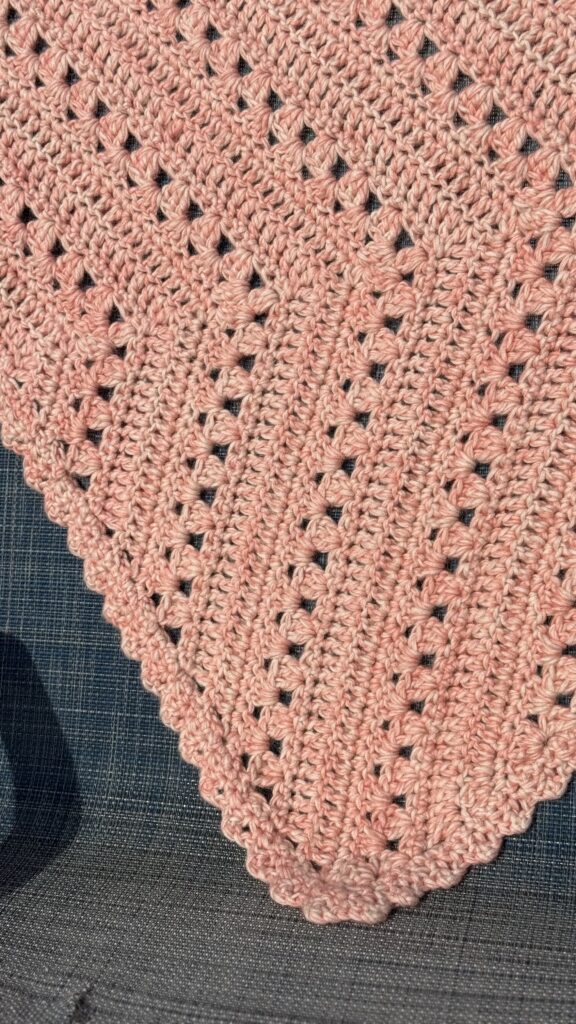
6-Day Crochet refers to alternating rows or rounds of sc, dc, and clusters, sometimes with and sometimes without chevrons. The name of the pattern came from the original 6-Day Kid Blanket, which was toddler sized and made with chunky yarn, and just happened to take me an easy six days to make.
For more information please see my article, Why is it Called the 6-Day Kid Blanket?
This pattern as written can easily be completed in six days, but there is no challenge or rush. Enjoy the process.
Row Numbering
All 6-Day Crochet patterns have a consistent numbering for the characteristic six rows of the signature stitch. Rows 2 and 3 are always cluster rows, Rows 5 and 6 are always dc rows, and rows 4 and 7 are always sc rows. Row numbering in the pattern may not always be consecutive and you’ll be directed where to go next.
Stripe
There are many ways to adapt the 6-Day Crochet stitch sequence by changing colors on different rows or adding texture to create a completely different look with the same stitches. Some of the different stripes are referred to as Vivid Chevrons (the original), The Snowflake Effect, Viral Stripe, Sweetheart Stripe, Popsicle Effect, and Ridgy Didge. This chevron-less version of the 6-Day Crochet stitch is referred to as the Tranquility Stripe.
No specific color changes are given in this version. For more information about different ways to stripe your 6-Day Crochet projects, please see my article No Two 6-Day Kid Blankets Are Alike.
Community Support
The best way to get support if you have questions about this pattern is through my Facebook community dedicated to helping crocheters with the 6-Day Crochet Projects. It’s loaded with free resources and people to answer your questions, cheer you on, and appreciate your finished projects.
Join my membership community The Betty McKnitiverse and ask questions directly during one of my many community zoom calls.
Begin Pattern
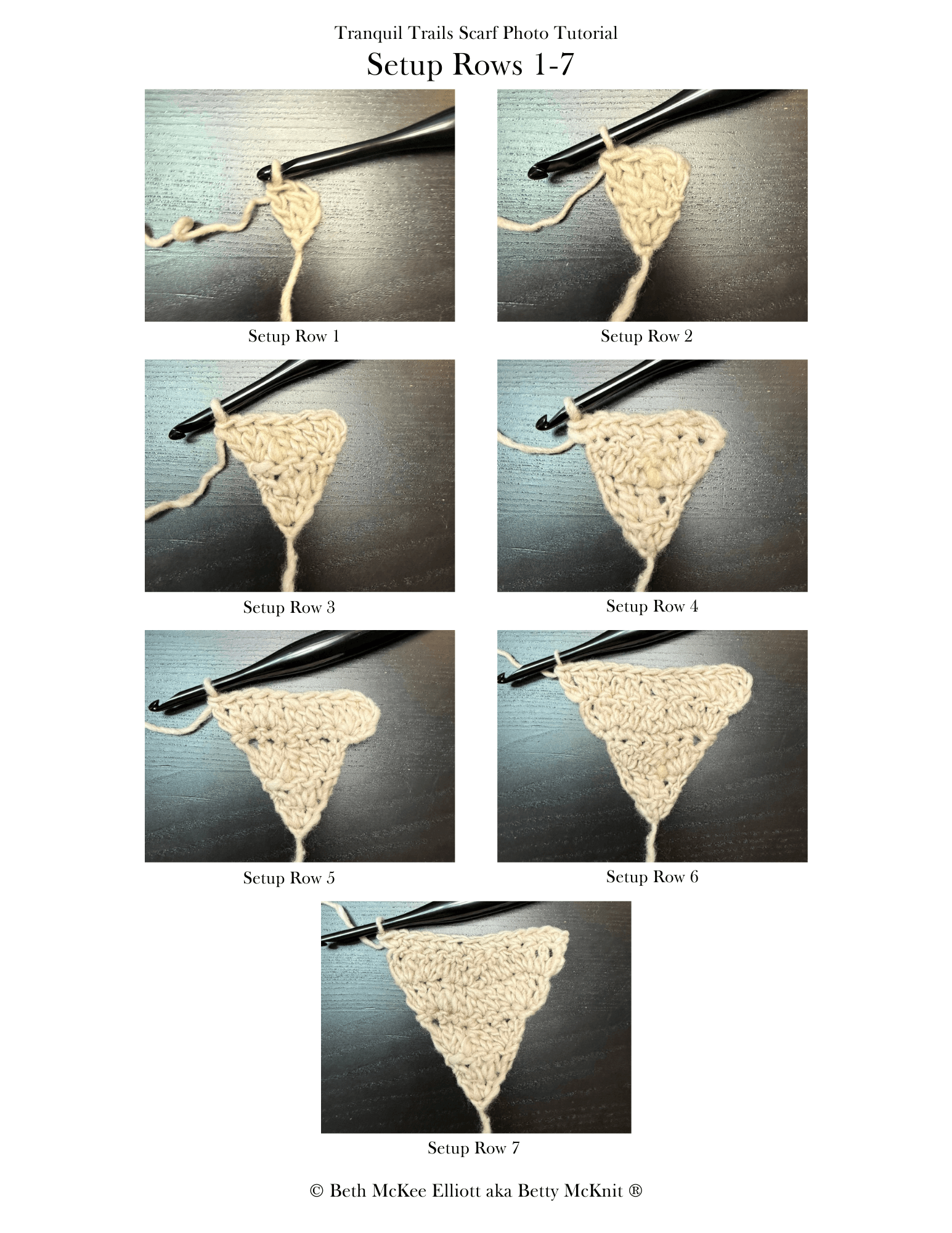
Setup Rows
Setup Row 1: ch 3, 2 dc in first ch. Turn.
<3>
Setup Row 2: stsc, 2 dc in next st.dc in top of ch 3. Turn.
<4>
Setup Row 3: stsc, 2 dc in same st, dec dc2tog over next 2 sts, 3 dc in last st. Turn.
<7>
Setup Row 4: ch 1, 2 sc in same st, sc in next 2 sts, sk 1, sc in next 2 sts, 2 sc in last st. Turn.
<8>
Setup Row 5: st3sc, edc in same st, 2 dc in next st, dc in next st, dc2tog over 2, dc in next st, 2 dc in next st, (dc edc) in last st. Turn.
<11>
Setup Row 6: st3sc, edc in same st, 2 dc in next st, dc in next 2 sts, dc2tog over 3, dc in next 2 sts, 2 dc in next st, 2 edc in last st. Turn.
<13>
Setup Row 7: ch 1, 2 sc in same st, sc in next 4 sts, sc2tog over 3, sc in next 4 sts, 2 sc in last st. Turn.
<13>
Setup Rows Complete. Proceed to Increase Section Rows 2-7. Do not repeat the Setup Rows.
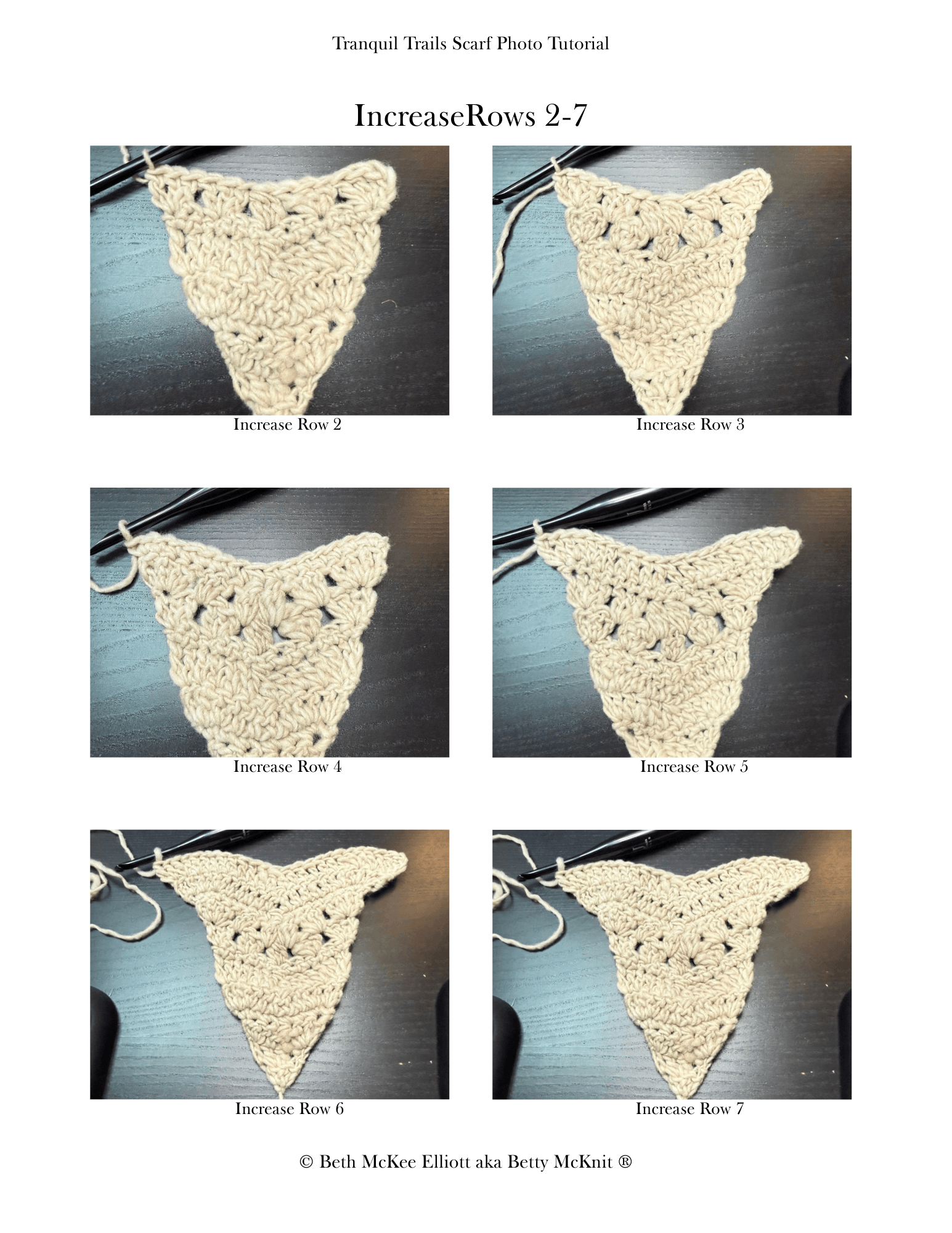
Increase Section
Increase Row 2: (st3sc, edc, dc) in same st, [sk 2, 3 dc in next st] 1 (3, 5, 7, 9, 11, 13, 15, 17, 19, 21) x, sk 2, dc3tog, [sk 2, 3 dc in next] 1 (3, 5, 7, 9, 11, 13, 15, 17, 19, 21) x to last 3 sts, sk 2, (2 dc, edc) in last st. Turn.
<13, 25, 37, 49, 61, 73, 85, 97, 109, 121, 133>
Increase Row 3: (st3sc, edc, 2 dc) in same st, 3 dc in next 1 (3, 5, 7, 9, 11, 13, 15, 17, 19, 21) sp(s), dc3tog in next 2 sps, 3 dc in next 1 (3, 5, 7, 9, 11, 13, 15, 17, 19, 21) sp(s), (2 dc, 2 edc) in last st. Turn.
<16, 28, 40, 52, 64, 76, 88, 100, 112, 124, 136>
*Hint: Check for halfway point after this row – you must end this section after Increase Row 3.
Increase Row 4: ch 1, 2 sc in same st, sc in next 6 (12, 18, 24, 30, 36, 42, 48, 54, 60, 66) sts, sc2tog, sc in each st to last st, 2 sc in last st. Turn.
<17, 29, 41, 53, 65, 77, 89, 101, 113, 125>
Increase Row 5: (st3sc, edc in same st), 2 dc in each of next 2 sts, dc in next 4 (10, 16, 22, 28, 34, 40, 46, 52) sts, dc2tog over 3, dc in each st to last 3 sts, 2 dc in each of next 2 sts, (dc, edc) in last st. Turn.
<21, 33, 45, 57, 69, 81, 93, 105, 117, 129>
Increase Row 6: (st3sc, edc in same st), 2 dc in next 2 sts, dc in next 6 (12, 18, 24, 30, 36, 42, 48, 54, 66) sts, dc2tog over 3, dc in each st to last 3 sts, 2 dc in each of next 2 sts, (dc, edc) in last st. Turn.
<25, 37, 49, 61, 73, 85, 97, 109, 121, 133>
Increase Row 7: ch 1, 2 sc in same st, sc in next 10, (16, 22, 28, 34, 40, 46, 52, 58, 66) sts, sc2tog over 3, sc in each st to last st, 2 sc in last st. Turn.
<25, 37, 49, 61, 73, 85, 97, 109, 121, 133>
Repeat Increase Rows 2-7 until you have used nearly ½ of your yarn, or you are ready to decrease.
Repeat Rows Increase Rows 2 and 3 once more. You must end this section on row 3.
Take note of your stitch count.
Proceed to Decrease Rows
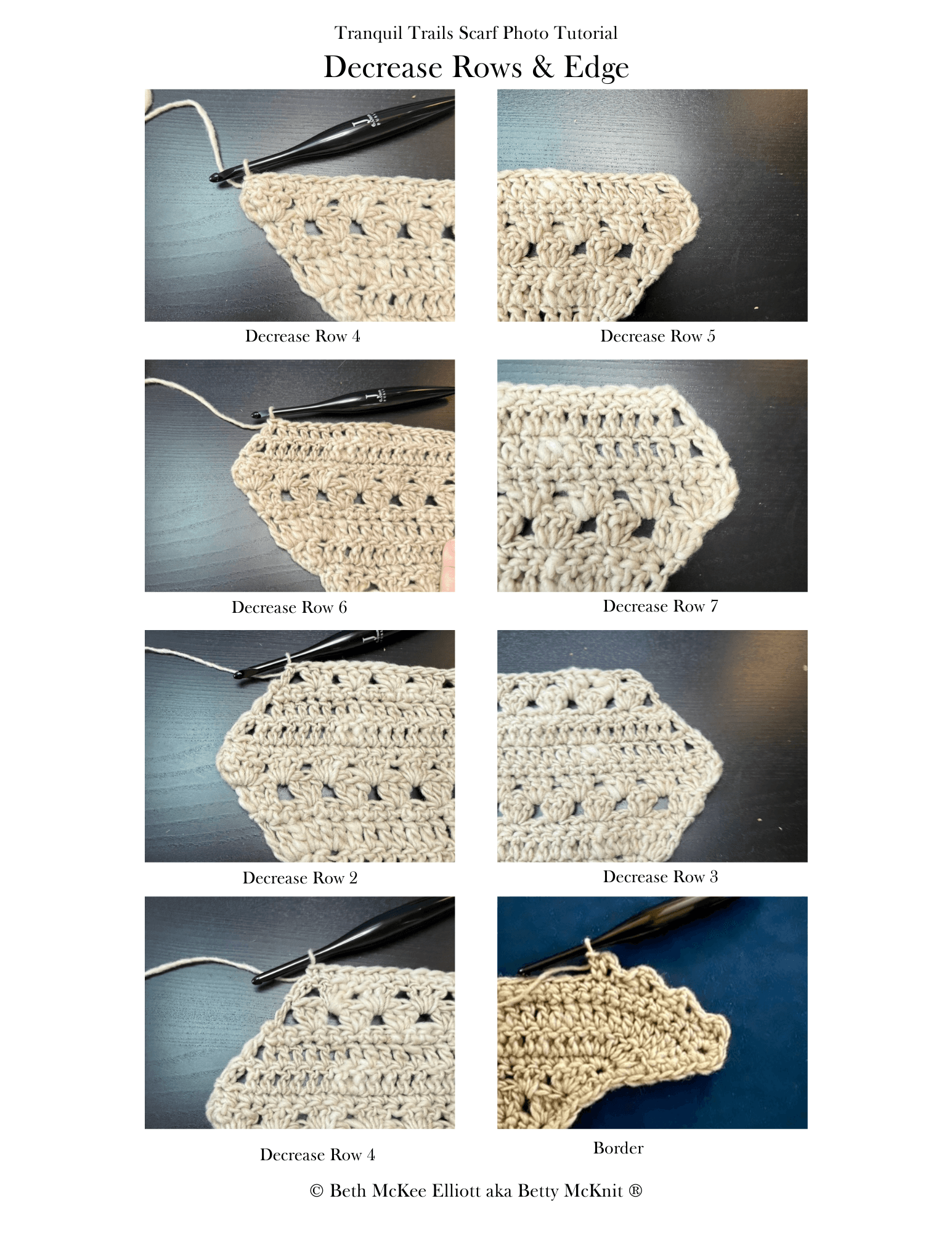
Decrease
The Decrease Rows begin at Row 4.
Decrease Row 4: ch 1, 2 sc in same st, sc in each st to first dc2tog, sc2tog over next 2 sts, pm in sc2tog, sc in each st to last 2 sts, sk 1 sc in last st. Turn.
<+/-1>
Decrease Row 5: st3sc, sk 1, dc in to one st before marker, dc2tog over 3, pm, dc in each st to last 3 st, 2 dc in each of next 2 sts, (dc, edc) in last st. Turn.
<+/-0>
Decrease Row 6: (st3sc, edc) in same st, 2 dc in each of next 2 sts, dc to one st before marker, dc2tog over 3, pm, dc to last 2 sts, sk 1, dc in last st. Turn.
<+/-0>
Decrease Row 7: ch 1, sc in same st, sk 1, sc to one st before marker, sc2tog over 3, pm, sc to last st, 2 sc in last st. Turn
<-2>
Continue the Repeat sequence 2-7, picking up at Row 2.
Decrease Row 2: (st3sc, edc, dc) in same st, [sk 2, 3 dc in next st] to 2 sts before marker, dc3tog in marked st, pm, [sk 2, 3 dc in next] to last 3 sts, sk 2, edc in last st. Turn.
<-2>
Decrease Row 3: st3sc, sk sp bet edc and 3 dc, [3 dc in each sp] to sp before marker, dc3tog in next 2 sps, 3 dcin each sp to end, (2 dc, 2 edc) in last st. Turn.
<-1>
Decrease Row 4: (ch 1, 2 sc) in same st, sc in each st to first dc2tog, sc2tog over next 2 sts, pm in sc2tog, sc in each st to last 2 sts, sk 1 sc in last st. Turn.
<-1>
Decrease Row 5: st3sc, sk 1, dc in to one st before marker, dc2tog over 3, pm, dc in each st to last 3 st, 2 dc in each of next 2 sts, (dc, edc) in last st. Turn.
<+/-0>
Decrease Row 6: (st3sc, edc) in same st, 2 dc in each of next 2 sts, dc to one st before marker, dc2tog over 3, pm, dc to last 2 sts, sk 1, dc in last st. Turn.
<+/-0>
Decrease Row 7: (ch 1, sc) in same st, sk 1, sc to one st before marker, sc2tog over 3, pm, sc to last st, 2 sc in last st. Turn
<-2>
Repeat Decrease Rows 2-7 until only one st remains between dc2tog over 3 and last dc of Decrease Row 6.
Work the final Decrease Row 7 as follows:
Last Decrease Row 7: ch 1, sk 1, sc to last st, 2 sc in last st.
<-1>
If you do not happen to end on row 7, complete your last decrease as written in the row in which you finish. The goal is to have as straight an edge as possible.
Continue to Edge, if desired, or finish off.

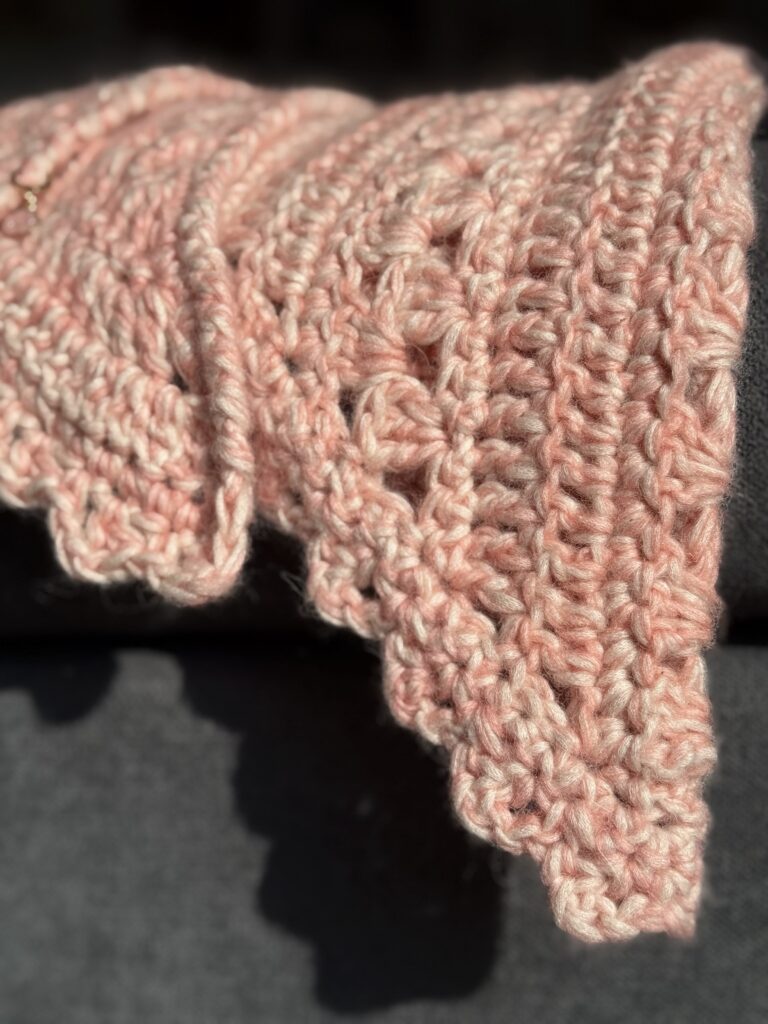
Edge
Edge Round 1: (RS) ch 1, 2 sc in first st, sc in each st and continuing to sides of sts where the
last row 7 ends creating a continuous line across the side of the scarf to the corner.
When working sc into the sides of stitches, treat sc and dc stitches as foundation chains, working under 2 threads of each stitch and leaving one thread below, and treat the st3sc as single crochet working one stitch into each.There is no set rule for how many stitches you should put into the side of each stitch. Lay your work down often and check to make sure that your edge does not ruffle (too many stitches) or pull (too few).
When you reach the center corner, work 3 sc in side of sc of first decrease row 4. Continue to work sc into sides of stitches to corner where the scarf started, work 3 sc in corner. Work sc in sides of stitches along the long side as before, working 3 sc in side of first sc of round. Do not turn.
Continue to Edge Round 2
Note: I find it perfectly acceptable to only edge the short sides of triangular scarves. It’s also perfectly fine to edge all three sides too. These directions are for putting an edge around the entire scarf. It’s your personal choice how you would like the edges of your scarf to look.
Edge Round 2: *ch 1, dc in next st, ch 1, sc in side of dc just made, sk 1, sc in next st. repeat from * around. Join with sl st to first ch 1. Fasten Off.
Weave in all ends and block.
Credits
Tested by Maya Cook, Juli Frazier, Tanya Fredock, Deborah Shoemaker, and Kristen Sniadowski.
This pattern is the intellectual property of Beth McKee Elliott aka Betty McKnit®. This pattern, The 6-Day Kid Blanket, 6-Day Crochet™, 6-Day Star Blanket™, and all derivative works are protected by copyright. Publishing translations, corrections, variations, or tutorials of this pattern, online or elsewhere without written permission from the owner is a violation of copyright.
Items created with this pattern may be used for commercial sale with credit to Betty McKnit in your listing. Mass production is not permitted.
The 6-Day Crochet stitch pattern was inspired by “Vivid Chevrons” #110 from 200 Ripple Stitch Patterns by Jan Eaton.
This page contains affiliate links. If you click these links and buy something on the page they take you to, I may, at no additional cost to you, earn a commission. I only affiliate with products and companies I feel good about. Thank you for your support!